image_1751957963369.webp

January 20, 2025

Pakistan’s industry is teetering on the brink of collapse, with policies that are actively dismantling it.

Chief among the culprits is the prohibitive cost of energy, driven by a deeply dysfunctional energy sector. Without urgent reforms to rationalize and reduce energy costs to globally competitive levels, Pakistan will remain trapped in a cycle of stagnation, incapable of exploiting its industrial potential to stimulate exports and generate sustainable income growth and development.

Instead of enabling growth, current policies are accelerating deindustrialization, decimating well-established sectors of the economy. The textile value chain, particularly the spinning and weaving sectors, are glaring examples. These sectors are integral not only for export earnings but also for sustaining employment and supporting ecosystems of livelihoods. Yet, they are now in existential peril due to energy costs that are nearly double those of competitor countries, coupled with counterproductive fiscal policies.

With grid tariffs in Pakistan between 13-16 cents/kWh compared to 5-9 cents in competing countries and energy accounting for up to 54% of conversion costs across the textile value chain, another major blow came with the withdrawal of the zero-rating and sales tax exemption on local supplies for export manufacturing. This policy subjected domestic inputs to an 18% sales tax while imports of the same goods remain duty- and tax-free under the Export Facilitation Scheme. Such a policy defies economic logic and international trade norms, including those under the WTO framework, which emphasize creating a level playing field between local industries and imports. Countries worldwide often tilt the playing field to protect their domestic industries. Pakistan, conversely, has done the opposite—effectively subsidizing foreign manufacturers while taxing its own. The result has been devastating for local production, creating distortions that undermine the competitiveness of Pakistani products in both domestic and global markets.

However, even if this fiscal imbalance were rectified, Pakistan’s textile sectors would still face insurmountable challenges. Energy costs remain the principal bottleneck. Yarn and cloth produced domestically are uncompetitive against imports even after paying customs duties, regulatory duties, and sales tax on imports. Energy is the primary driver of this disparity, eroding the global competitiveness of Pakistan’s exports and dismantling energy-intensive upstream segments of the textile value chain.

Pakistan is uniquely positioned as one of only three countries in the world with a complete textile and apparel value chain—from cotton growing, spinning, and weaving to apparel manufacturing. This integrated ecosystem is a key advantage in an era where global buyers prioritize supply chain resilience. Geopolitical tensions and increasing risks in global value chains (GVCs) have made it imperative for brands to diversify sourcing towards destinations with full value chain capabilities. Pakistan could be a viable alternative to countries like China, but its potential is severely undermined by domestic policies that systematically dismantle its textile value chain.

Some argue that Pakistan’s recent uptick in textile exports suggests resilience. This claim is misguided. The uptick merely reflects partial recovery following the disruption of Bangladesh’s textile industry, which diverted temporary orders to Pakistan. With Bangladesh’s operations now restored, this artificial boost is unlikely to be sustained. Moreover, textile exports peaked at $19.3 billion in FY22, and the country is still struggling to reach that level. Even if growth resumes, the potential for export expansion is capped at approximately $25 billion due to limited production capacity—an unachievable target under the prevailing energy prices and punitive business environment.

Industrial policy is also about more than export earnings; it is equally about employment generation and sustaining economic ecosystems. The textile industry in Pakistan drives job creation across the value chain, from farming communities in the cotton economy to skilled and semi-skilled workers in textile production hubs. Policies that drive deindustrialization have devastating consequences for millions of livelihoods, increasing unemployment and exacerbating social inequality. With negligible investment in productive sectors, these displaced jobs are not being replaced, compounding the country’s economic woes.

Furthermore, the reliance on imports to replace domestic inputs undermines net foreign exchange earnings. While a few large exporters may sustain themselves by adding value to increasingly imported inputs, this model results in lower overall domestic value addition. Import dependence erodes the broader industrial ecosystem and does not add enough to, if not taking away from, foreign exchange reserves, leaving the country even more vulnerable.

A comprehensive and urgent overhaul of energy and fiscal policies is essential to halt the ongoing deindustrialization and unhamper the country’s economic potential. Restoring the zero-rating and sales tax exemption for export-oriented local supplies is a necessary first step to level the playing field for domestic industries. However, fiscal adjustments alone will not suffice. The energy sector demands radical reform to enable globally competitive costs for industrial consumers.

Most importantly, grid power tariffs must be reduced to a competitive 9 cents/kWh for industrial users. Second, the Competitive Trading Bilateral Contract Market (CTBCM) must be operationalized. This would enable industrial consumers to procure clean electricity at competitive prices through B2B contracts while also meeting net-zero requirements and preparing for the EU’s Carbon Border Adjustment Mechanism. To make it successful, however, the use of system/wheeling charge must be set at a financially viable 1-1.5 cents/kWh, excluding cross subsidies and stranded costs, as opposed to proposed charge of ~10 cents/kWh by the CPPA-G that is unsustainable, negates the benefits of competitive electricity procurement, and is more than the full cost of electricity in competing countries.

In the gas sector, the government must refrain from shutting off gas supply to captive power plants only to force their users to the grid. Power availability and grid infrastructure is not equipped to absorb the additional load from captive users, as acknowledged by the Secretary Power Division before the Senate Standing Committee on Energy. In Karachi, for instance, there is not enough physical space to install grid stations to service current captive users, while the grid infrastructure under HESCO is too old and outdated to support large industrial loads. Many industrial users across the country lack grid connections or sufficient sanctioned load and face prohibitive costs and delays of up to three years for new connections and load enhancement. Until the necessary grid infrastructure is in place and power tariffs are reduced to a competitive 9 cents/kWh that automatically incentivize a transition to the grid, policies that restrict gas supply to captive generators and force an unnatural switch to the grid will only exacerbate the challenges faced by industry.

Grid reliability is another critical issue. Export-quality textile production cannot tolerate frequent power outages, fluctuations, or blips, which cause costly disruptions and damage sophisticated machinery. Many industries have also invested in high-efficiency combined heat and power (CHP) plants that not only generate electricity but also produce the steam and hot water required for industrial processes. Forcing these industries to rely solely on grid electricity would require additional investment in inefficient gas-fired boilers, raising operational costs and wasting valuable gas resources. In any case, “captive” gas tariffs are just a misnomer invented to justify discriminatory pricing for different industrial uses. In-house power generation, as also declared by the Supreme Court, is in fact an industrial process just like other industrial applications as long as the power generated is used to add value within the same industrial facility.

Gas supply to captive users must thus continue to such units at ring-fenced RLNG prices with rationalized UFG and no gross subsidies in the immediate term. Simultaneously, the gas sector must be liberalized to reduce inefficiencies and encourage competitive procurement. Industrial users should have the option to import RLNG directly and access 35% of new domestic gas discoveries under the direct access policy approved by the CCI. It is of utmost importance to open up the energy markets and allow industries to choose whichever energy source makes them competitive, be it grid electricity or gas-fired captive generation.

Pakistan’s economic crisis cannot be resolved without addressing these systemic issues crippling industrial sectors. A vibrant, competitive industrial base is the foundation of sustainable economic growth, employment, and export earnings. Current policies are dismantling this foundation, with energy costs and fiscal distortions driving deindustrialization. Policymakers must act decisively to create a level playing field for local industries, rationalize energy costs, and foster an environment conducive to exports, investment and economic growth.
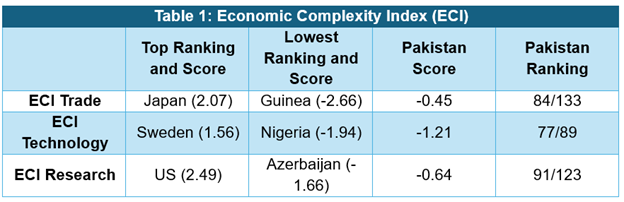
image_1751956532276.webp

January 9, 2025

Almost three years into Pakistan’s economic crisis, the illusion of stability in indicators like the exchange rate and inflation without a resurgence of capital and forex inflows offers little reassurance about the future of the economy and country.

Rather than recovery, the current stability is more a function of stifled growth. Inflation was reported at 4.1% in December 2024, but this owes more to a demand-side recession than meaningful progress. The economic slowdown has subdued price increases as incomes and purchasing power remain well below pre-crisis levels, reflected in dismal GDP growth of 0.92% for the first quarter of FY25, including a 1.03% contraction in industrial output.

The underlying fragility of this stability amidst the absence of growth is unmistakable as economic policies appear to be a deliberate recipe for economic self-destruction. Manufacturing industries are buckling under the weight of exorbitantly high energy prices, compounded by uncertainty regarding continuation and affordability of gas supply for captive power generation. At the same time, following changes in the Export Facilitation Scheme, local industry has been subjected to an 18% sales tax on inputs for export manufacturing, while imports of the same remain exempt from both duties and taxes. This dual pressure has brought industrial sectors, particularly the textile value chain, to the brink of collapse.

The government’s withdrawal of the sales tax exemption on local supplies under EFS has placed Pakistani cotton growers, spinners and weavers at a significant disadvantage. This mindless policy has crippled domestic producers, leaving them unable to compete with counterparts in the United States, Brazil, China, Uzbekistan, and beyond. Unsurprisingly, the consequences have been devastating. Around 25% of spinning mills have already shut down, and others are operating at less than half their capacity.

The spinning sector now stands at the edge of ruin. With over 12 million installed spindles, the sector has the capacity to consume more than 16 million bales of cotton annually. Its collapse would unravel the entire textile value chain, starting with cotton farmers, whose livelihoods depend on a thriving spinning industry to sustain demand for their crop. Cotton farming, which injects $2–3 billion annually into the rural economy, provides a lifeline to some of Pakistan’s most vulnerable communities. The ripple effects of its decline would exacerbate rural poverty, disproportionately impacting women, who form a significant share of the labour force in cotton-picking and related activities. A deteriorating rural economy would further depress household incomes, reduce spending power, and deepen the already stark inequalities in marginalized regions.

It also puts at risk the government’s agricultural revival initiatives like the Green Pakistan Initiative that include large-scale cotton cultivation as a cornerstone. These plans are doomed without a robust spinning sector to sustain demand for domestic cotton. The IMF’s prohibition on crop support pricing has further exacerbated the challenges faced by farmers. Without guaranteed profitability, farmers have little incentive to cultivate cotton, particularly as the industrial base that once supported them crumbles. It is important to recognize that Pakistan’s cotton, characterized by higher trash and moisture content and smaller bale sizes, is not suited for international markets. Its primary utility lies in local consumption, making domestic demand critical to sustaining the cotton economy.

By mid-2024, domestic production of yarn was down by over 40% YoY, and the situation has significantly worsened since then. This sector has absorbed billions of dollars in investment over the years, most recently under TERF, and plays a pivotal role in supporting the country’s export-oriented economy. Its collapse would represent not just a devastating loss of industrial capacity but also a sunk cost of over $15 billion. The spinning sector is the key link between the cotton economy and downstream industries like weaving, dyeing, and garment manufacturing. If this sector is allowed to wither, it will trigger a catastrophic loss of employment and economic activity.

The onslaught does not end with domestic policies. Chinese cotton yarn, largely produced using Xinjiang cotton, has flooded Pakistani markets at prices local producers cannot match. With significantly lower energy (electricity priced at 5 cents/kWh) and other input costs, and much higher productivity, China’s dumping of cheap yarn has further devastated Pakistan’s spinning industry. This issue is now also complicated by geopolitical risks. Xinjiang cotton faces sanctions from the United States, and the incoming US administration’s hardline stance on China could expose Pakistan’s economy and textile sector to additional vulnerabilities if domestic yarn continues to be replaced by imported, predominantly Chinese, yarn.

The energy crisis further compounds these challenges, rendering Pakistani spinning—where energy now accounts for around 54% of conversion costs, up from 35% two years ago–even less competitive. International competitors enjoy electricity tariffs ranging 5-9 cents/kWh while Pakistan’s industries face rates ranging 13-16 cents/kWh. Natural gas prices present a similar disparity, with local industries paying over $12/MMBtu, compared to $6–$9/MMBtu in competing countries. These input costs make Pakistani exports uncompetitive in global markets, even before factoring in duties and taxes.

The looming disconnection and price hikes of gas supply to industrial captive generation facilities has created further uncertainty regarding the future of the textile industry. The IMF is bent on forcing industries to transition to a prohibitively expensive and unreliable grid. The proposal of raising gas/RLNG prices to Rs. 4,100 per MMBtu plus a 5% levy, with plans for further hikes and additional levies, is equally disastrous as shutting off gas supply to captive power plants. Such measures would render in-house power generation financially unviable. Major textile companies have already begun shifting to alternatives like furnace oil-based generation—costlier and environmentally damaging options necessitated by the uncompetitive energy landscape.

Instead of enforcing unsustainable energy policies, the government should allow market principles to guide resource allocation. Industries must be permitted to import their own RLNG and operationalize the Council of Common Interests’ approved policy for direct procurement of up to 35% of new domestic gas discoveries. Only by securing access to competitively priced inputs can Pakistan’s industrial sectors grow, compete in global markets, and create jobs.

The economic implications of inaction are dire. If the spinning and cotton sectors collapse, Pakistan will be forced to increase reliance on imported inputs, eroding any gains from value-added textile exports. The resulting structural imbalance would undermine efforts to reduce the trade deficit and weaken the competitiveness of Pakistani exports.

International buyers are also changing their sourcing preferences. Recent disruptions to global value chains—ranging from the COVID-19 pandemic to the Ukraine war and climate change—have prompted buyers to favour suppliers capable of offering end-to-end solutions. This shift toward “super vendors,” who provide fully integrated supply chains from raw material to finished product, puts Pakistan at a disadvantage. The decline of the spinning sector would fragment the country’s textile value chain, diminishing its appeal as a sourcing destination and further shrinking its share of global markets.

Allowing this critical industry to wither would represent a colossal failure of governance, with far-reaching consequences for Pakistan’s economy. High energy costs, inequitable tax policies, and poor planning have placed the industry in a chokehold.

The current trajectory is unsustainable. Without immediate corrective action, the destruction of Pakistan’s spinning and cotton sectors will trigger a cascade of economic and social devastation. Millions of jobs are at risk, particularly in rural areas, where alternative employment opportunities are scarce.

The path forward is clear: the government must prioritize the survival of local industries. This means addressing the energy crisis, ensuring equitable tax policies, and fostering an environment where domestic producers can compete on a level playing field with international rivals which is most optimally achieved by restoring the Export Facilitation Scheme to its pre-Finance Act 2024 form, including the zero rating/sales tax exemption on local supplies for export manufacturing.  

The time for half-measures has passed. Failure to act will leave Pakistan as its own worst enemy.


image_1753074896485-1280x854.webp

January 8, 2025

By Shahid Sattar | Sarah Javaid
While the government celebrates its ambitious five-year Transformation Plan: The URAAN Pakistan, (2024-2029), the business community is left wondering how this will be achieved given the current economic environment.

The initiative structured around five core pillars: Exports, E-Pakistan, Environment, Energy & Infrastructure, and Equity, Ethics & Empowerment (5Es), has no implementation strategy.

All eyes are now on what new measures the government intends to introduce to liberate the industrial community from the recurring cycle of weak policy enforcement, which continues to hinder industrial growth, investment, and export expansion.

The document, which sets its sights on seeing Pakistan “among the ten largest economies of the world by 2047” alongside a target of USD 50 billion in exports over the next four years (though some pages of the document suggest USD 60 billion), is unlikely to lead to any policy shift.

Such policy frameworks have been introduced repeatedly in the past – with little or no real impact.

Meanwhile, the textile industry, the country’s leading export sector, continues to be suffocated by unrealistic tax regimes, the removal of zero-rating on local inputs for export manufacturing, exorbitant energy prices, regressive policies on captive power plants, and declining cotton production.

Team URAAN must recalibrate its approach by reversing these policies and redirecting its efforts toward addressing the real issues.

Textile exports remain the first line of defense:

Pakistan’s import dependency is precarious. Initially concentrated on petroleum products and machinery, imports have expanded to cover a broad range of food commodities, including palm oil, tea, and pulses, driving up the import bill.

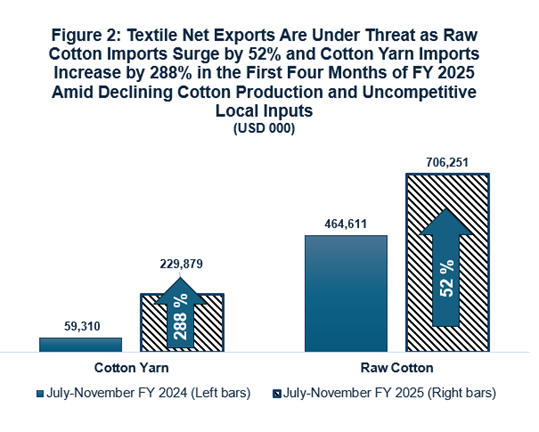
Alarmingly, this trend is now extending to the textile sector. The rising import of raw cotton is particularly concerning, surging to USD 1.7 billion in FY 2023 and already reaching USD 706 million in the first four months of FY 2025, a more than 50% increase from the same period last year.

Once self-sufficient in cotton, Pakistan has now become a major net importer; in fact, the largest importer of U.S. cotton; a shift driven by successive crop failures.

With that, production costs for key crops, including cotton, have doubled since 2023, further increasing the sector’s reliance on imports.

The country’s export mix is rapidly deteriorating. Apart from IT and agricultural exports -which remain opportunistic and unreliable – textile exports are the only glimmer of hope for Pakistan’s balance of payments and therefore require urgent attention and support.

Yet, the sector is facing increasing pressure from government policies that threaten its long-term sustainability.

Export diversification will come with the right infrastructure:

Diversifying the product mix and export markets is essential for Pakistan’s export growth. However, advancing sophistication and value addition requires the country to ascend the economic complexity ladder – an area that has consistently been neglected and remains uncertain.

Pakistan ranks 85th in economic complexity globally as of 2022, unchanged since 2000. This stagnant position highlights the country’s ongoing struggle to produce technologically advanced goods and services, with negative performance across key indicators such as trade, technology, and research (Table 1).

The IT sector stands out as a relatively more complex industry with growth potential. However, unstable connectivity and frequent internet slowdowns cast a long shadow over ambitions to expand IT exports. Without guaranteed, reliable infrastructure, investment in the sector will remain elusive.

In a country always grappling with basic internet stability, the transition to the 4th and 5th Industrial Revolutions is more of a distant aspiration than an imminent possibility. Until critical infrastructure gaps are addressed, Pakistan’s vision of entering the 5th industrial revolution – as highlighted in the document – will remain unachievable.

Forced pre-mature deindustrialization:

The 5th industrial revolution remains a distant goal; instead, Pakistan’s policy landscape is driving key industries, including textiles, toward premature deindustrialization.

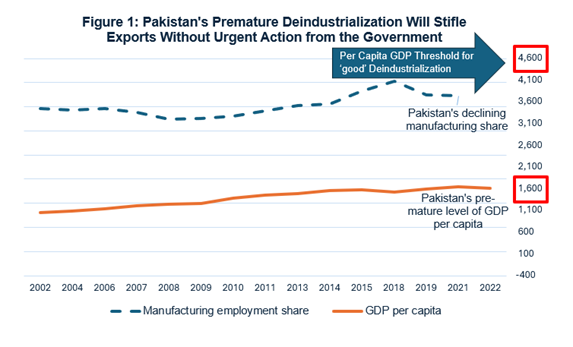
Historically, the textile sector benefited from a vertically integrated value chain, keeping import dependency low by relying on local raw materials such as cotton and intermediates like yarn. However, with over 25% of spinning units closed, other units operating at 50% or less capacity, and millions of jobs lost – adding to the 4.5 million already unemployed in the economy – the industry is now on the path to rapid deindustrialization, especially as the share of manufacturing in the country continues to decline (Figure 1).

This industrial decline is contributing to rising poverty, which has become a growing concern. According to a recent World Bank report, high inflation has deepened poverty in non-agriculture sectors, with the poverty rate rising to 40.5% in FY24, up from 40.2% in FY23. As industrial activity slows and employment opportunities dwindle, an additional 2.6 million Pakistanis have fallen below the poverty line, and this number is likely to increase rapidly.

Deindustrialization typically occurs as economies progress and per capita incomes rise beyond middle-income levels. However, Pakistan remains far below this threshold. The country’s premature deindustrialization, driven by the shutdown of upstream industries, risks triggering severe economic disruptions.

Considering this troubling trend, achieving export-led growth will not be possible unless critical policy reforms are undertaken.

Counterproductive economic policies come with a significant economic cost:

This premature deindustrialization is largely driven by the government’s counterproductive economic policies, particularly the heavy tax burden and frequent policy shifts that exacerbate the challenges faced by the textile industry.

The FY25 budget has placed exporters under the normal tax regime, subjecting them to a 1% advance minimum turnover tax, adjustable against a 29% final income tax, along with an additional super tax of up to 10%. Despite this, exporters are still required to pay a 1.25% advance tax on export proceeds (including a 0.25% export development surcharge). Subjecting exporters to double taxation is unjustified and discriminatory, particularly given that textile businesses operate on high volumes and low margins.

No other country taxes its export sector in such an illogical manner. Achieving USD 50 billion in exports within four years under this tax structure is nothing short of absurd.

This is further compounded by the removal of zero-rating on local supplies for export manufacturing under the EFS, leading to an 18% sales tax that undermines competitiveness by making domestically sourced raw materials more expensive than imported alternatives, which are exempt from both duties and sales tax. As a result, exporters have shifted to imported inputs, with imports of raw cotton and cotton yarn surging by 52% and 288%, respectively, in the first four months of the current fiscal year compared to the same period last year (Figure 2).

Adding to the financial strain, the sales tax refund system is plagued with delays, with refunds often taking six months or longer – or, in most of the cases, partially deferred, further intensifying the burden on exporters. As highlighted in the World Bank’s Economic Memorandum, the current tax regime in Pakistan is ‘complex and opaque,’ with refunds taking an average of 18 months to process, as compared to the 72-hour timeline stipulated under the sales tax rules.

In addition to these challenges, the government’s decision to cut gas supplies to the CPPs has dealt a further blow to the industry. How can team URAAN pursue USD 50 billion in exports while implementing policies that make it impossible to even maintain the current export levels?

Revival of fresh investment and the upgradation of industrial plants are the need of the hour:

As Milton Friedman once observed, trade deficits are not inherently harmful. The true concern arises when trade imbalances coincide with fiscal mismanagement, as is the case with Pakistan.

A few years ago, Pakistan was a cotton exporter. Today, it has transformed into a net importer, becoming the largest buyer of U.S. cotton. How much longer can Pakistan sustain this growing import dependency without seeing a corresponding boost in exports?

For Pakistan to achieve export-led growth, it is imperative to safeguard every segment of the value chain, with an emphasis on reducing import dependency wherever possible. The ongoing decline in cotton production and the closure of textile units will continue to undermine net exports. Preserving progress in value-added textile exports is critical to prevent turning the balance of trade into a zero-sum game.

In this context, reassessing Pakistan’s corporate tax structure is urgent, as the current burden stifles investment. The EFS must be reinstated to its pre-Finance Act 2024 form, including the zero-rating of local supplies used in export manufacturing. This restoration is essential to ensure fair competition for domestic producers against imported substitutes, which has become critical as businesses face closure due to the changes in EFS rules.

Cotton remains the cornerstone of Pakistan’s textile industry, and immediate action is needed to enhance domestic production. Declining cotton yields, driven by factors such as the lack of climate-resilient seeds, limited mechanization, and insufficient advisory services, are costing Pakistan an estimated USD 4 billion annually in direct losses, along with USD 15 billion in GDP, as per our estimates.

In short, the government’s 5E framework cannot drive export growth if businesses remain stifled under oppressive tax regimes and structural challenges. Pakistan must avoid premature deindustrialization and focus on safeguarding net exports by addressing these issues and adopting the proposals outlined above.

Without delay, the team URAAN needs to prioritize fixing structural issues faced by the businesses, rather than focusing on repetitive rhetoric.


LOCATIONS

Where We Are


GET IN TOUCH

Follow Our Activity


IslamabadKarachiLahore