Dr. Gohar Ejaz
Pakistan’s economy has been facing a number of challenges in recent years, including low growth, high inflation, large fiscal and current account deficits, and declining foreign exchange reserves. Despite various efforts to spur economic growth, the country’s GDP growth rate has remained relatively low, averaging around 3-4% in recent years.
In the last 5 years, Pakistan has received a total of $32 billion as loans from various sources including China, Saudi Arabia, Abu Dhabi, World Bank, and the Asian Development Bank. In contrast, Pakistan has while earned $140 billion from exports. Expats have contributed $140 billion as worker’s remittances to the country during the same period. Given these inflow volumes and the eighty-twenty rule, Pakistan should focus on these two sectors aligned with relative weights of the expected outcome.
Composition of Foreign Economic Assistance, Remittances and Textile Exports (USD Million)

* Of which, 2500 Million USD is part of cyclical one time facility by ADB and 500 Million from AIIB Special Fund.
**State Administration of Foreign Exchange (SAFE) Authority, China.
***Saudi Fund for Development (SFD) Time Deposits.
Both exports and worker’s remittances are important sources of foreign currency for Pakistan and play a crucial role in its balance of payments, contributing 80% of total forex revenues. However, the relative economic importance of these two sources is significantly different where exports contribute directly to GDP growth, employment generation and provide the only sustainable long-term solution. Worker’s remittances on the other hand provide limited and indirect support to the GDP, as well as employment and are not considered as preferential source of forex.
Pakistan’s exports have seen an upward trend especially during FY20-FY22 where textile exports grew by a phenomenal 55% in just two years. Worker’s remittances also posted a growth of 50% in these two years but are dependent on the world economic conditions especially the state of the economies from which they originate and hence not considered stable or sustainable in the long run.
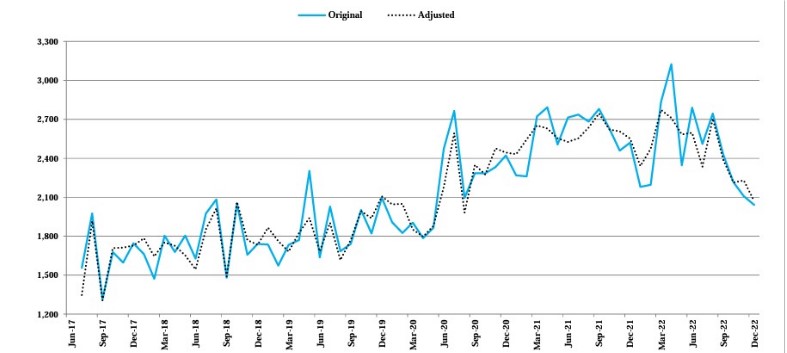
However, the state of remittances as well as exports is now depicting an alarming future. During H1 of the current fiscal year, remittances from 10 European Union countries (including Italy, Spain, Germany, France and Greece) sent to Pakistan showed negative growth. The number of remittances from EU member countries decreased from $1.750 billion in the same period of the previous fiscal year to $1.544 billion, representing a decrease of 11.77%.
Remittance Inflow (Jun’17 – Dec’22) in USD Million

Source: State Bank of Pakistan
With continued socioeconomic turbulence, Pakistan has always been relying on Foreign Economic Assistance (FEA) in various forms. FEA refers to government aid aimed at enhancing the economic growth and well-being of developing nations. This aid can take the form of concessional loans, grants, and technical support, and may be provided by both bilateral sources and multilateral organizations such as the World Bank, Asian Development Bank (ADB), Islamic Development Bank (IsDB), Asian Infrastructure Investment Bank (AIIB), or United Nations (UN).
Pakistan has had a history of being heavily dependent on FEA since its inception, which is not an ideal situation for a country’s long-term economic growth and development. There are several reasons for this:
First, reliance on FEA often leads to a lack of fiscal discipline and weak revenue collection efforts. Governments tend to rely on external aid to finance their spending, which can lead to large fiscal deficits and a buildup of government debt over time.
Second, FEA can create a culture of dependence, where the recipient country becomes reliant on external aid for its development and growth. This can lead to a lack of incentives for domestic reforms and a reduction in the country’s capacity to generate its own resources and finance its own development.
Third, FEA can distort the local economy by providing resources to sectors or projects that may not be aligned with the country’s domestic priorities or economic strengths. This can create a misallocation of resources and reduce the overall efficiency of the economy.
Fourth, FEA can also have negative impacts on the country’s currency, as large inflows of foreign aid can lead to an appreciation of the local currency and reduce the competitiveness of the country’s exports.
Pakistan attracted more than $25 billion in the real estate sector in 2021. According to a research study, 25-30% of remittances went into the real estate sector while 21-22% from the Roshan Digital Account were invested in the sector. Traditionally, expats have invested in real estate sector of Pakistan through remittances. A slowdown in the real estate sector necessarily negatively impacts investments and remittances. Remittances have decreased drastically over time, increased tax on property being the primary reason. Previously, even resident Pakistanis used to invest their savings in the real estate sector, however, exorbitant property tax rates have forced them to spend their savings in buying gold, and/or dollars, thus parking their funds in non-productive assets. In order to reverse the decline in worker’s remittances, overseas Pakistanis including non-resident persons may be exempt from advance tax payable under section 236K of the Income Tax Ordinance 2001 on the purchase of immovable properties in Pakistan. Expats may only be liable for Advance Tax on Sale/Transfer under section 236C of the Income Tax Ordinance 2001. This way remittances can be augmented to uplift Pakistan’s economic growth.
Focus on export growth necessarily involves promoting textiles as this sector contributes 62% of all exports. Pakistan’s textile industry, however, is facing a major crisis as it is rapidly losing credibility and competitiveness in the global market. The $19.3 billion industry, which relies heavily on exports, is experiencing a decline in global shipments. This situation is causing concern among its loyal international customers, who are becoming increasingly skeptical about the industry’s ability to meet deadlines and fulfill orders in a timely manner. The situation is further compounded by the shortage of dollars and basic raw materials, including cotton, dyes, and chemicals, which is causing many exporters to hesitate when booking new orders. As a result, the future of the industry looks uncertain, and unless measures are taken to address these challenges, the textile sector in Pakistan may continue to face a downward spiral.
Falling Textile Exports (USD Billion) – Targeted vs Expected in FY23

*Provisional-based on current trend.
Source: Author’s Own
Expanding our exports especially in the textile sector and removing all hurdles for remittance inflows should be of utmost importance. No doubt, we should also continue to maintain strong relationships with our current lending partners and work towards attracting investment from new sources. However, time has now come to consider that despite the current challenges faced by Pakistan’s textile industry, it is crucial that immediate steps are taken to re-invigorate the sector. Some of the critical steps are:
The cost of conducting business in the textile sector has become unmanageable due to the elimination of Zero-Rating (SRO 1125) and the implementation of a 17% GST on export-oriented industries. The high sales tax has led to an increase in working capital and interest rates, causing a surge in smuggling, fraudulent activities, and the import of second-hand clothing. To alleviate the situation and secure working capital, it is imperative to immediately reinstate Zero Rating for the entire textile sector through SRO 1125.
Address the looming liquidity crisis in the textile sector of Pakistan, caused by factors such as non-release of funds, high taxes, increased competition, and high energy costs. It is imperative to release all held-up funds such as deferred sales tax, TUF etc. as well as enhance working capital limits in accordance with rupee devaluation and increasing textile exports.
Moreover, in order to ease the liquidity crisis and avoid defaults, moratorium on capital repayment from July 1st, 2022 to June 30th, 2023 may be implemented during the period of this financial hardship to allow the industry time to stabilize and recover.
The current allocation of gas resources in the economy is unsustainable. To secure a sustainable gas supply and improve competitiveness, the priority of gas distribution to various sectors needs to be reevaluated. Priority should be given to productive sectors such as textile industry, with a focus on export-based industries over the domestic sector. This strategy would lead to increased exports, improved competitiveness, job creation, and a positive impact throughout the value chain. The current pricing disparities and promotion of non-productive use of limited resources in the gas sector should be addressed through reforms, such as the weighted average cost of gas (WACOG) and pricing that accurately reflects the economic value added through gas.
The maintenance schedule for industrial feeders disrupts 25% of the industrial production of businesses and negatively impacts industrial production and exports. The country is already facing low exports and industrial production, making it crucial to improve the quality of electricity supply. To address these issues, it is imperative to redouble efforts to improve the quality of electricity supply and mitigate the negative impact on industrial production and exports. The long-standing issue of provision of RCET’s to the entire textile value chain needs to be also resolved expeditiously. Likewise, the assessment and announcement of reasonable open excess charges of power (Wheeling) should also be promoted while it is also important to enhance the limit of 1 MW on solar to 5 MW for industrial net metering for promotion of alternative energy supplies. Increasing the limit of 1MW will also contribute to the economy by receiving the burden of setting up new solar plants providing them Take or Pay contracts and killer sovereign guarantees. The government must reconsider its decision to sponsor new solar projects given this very real alternative.
The curtailment on import of raw materials and spare parts has resulted in an acute shortage of both. This has led to non-maintenance of machinery, breakdown and running out of raw material leading to closure of textile mills. Urgent corrective action is needed.
To achieve economic and political independence, Pakistan must focus on its textile industry to get out of the debt cycle it is stuck in. To do this, it must prioritize adding value to its exports, especially in the highly productive textile sector, through supporting higher value addition. Investment and improvement in production and export capacity is crucial and requires a long-term textile policy and access to energy resources. Increasing exports will also help create jobs and prevent social and economic unrest.
In conclusion, while FEA can provide valuable resources for a country’s development, a heavy reliance on it can lead to a number of negative consequences for a country’s economy. It is important for countries to strive for greater self-reliance and to implement reforms that increase their own resource generation and strengthen their domestic economies. It is clear that the need for credit reoccurs regularly and that it is time for the country to consider reforms to break the cycle of debt and aid. Domestic initiatives and a genuine process that focuses on ground realities are crucial for implementing true and meaningful change.



Shahid Sattar and Noreen Akhtar
With the rising global trends in fast fashion, the export of textile waste or unwanted clothes to destinations outside the EU has steadily increased. This export reached 1.4 million tonnes in 2021. Around 2.1 million tonnes of post-consumer clothing and home textiles are collected in the EU annually for recycling or sale on global reuse markets. This represents around 38% of textiles placed on the EU market. The remaining get discarded in the mixed waste streams.
Pakistan is one of the dumping grounds for post-consumer textile waste or unwanted clothes discarded every year from the EU. In 2021, used clothing worth 46 million USD export value was exported from the EU to Pakistan. Used clothes from the EU’s high streets end up reaching resale markets and also, dumping sites in the country. In the absence of efficient traceability criteria and waste hierarchy in both the EU and Pakistan, that distinguishes between textile waste and second-hand textile products, the textile waste streams falsely labeled as second-hand clothes are imported to Pakistan, a major portion of which adds to the already mounting ecosystem challenges in the country. The unregulated waste streams of used clothing and lack of their recycling not only cause more GHG emissions and unsustainable water consumption, as this leads to the manufacturing of more new clothing, but also cause an increase in the dumping of textile waste in landfills.
EU is now giving utmost consideration to sustainability, promoting textile circularity, and regulating the export of textile waste streams to other nations. EU’s legislative reforms will change the game for Pakistan’s textile and secondhand clothing industry, which will not only significantly minimize the dumping of textile waste but also support the alignment of the current textile business models with the textile circularity business models.
CURRENT SCENARIO
Affordability and business through resale platforms are the massive forces behind large imports of used clothing from the EU to Pakistan. With the growing economic crisis, consumers have become mindful of their expenses and their preference for secondhand clothing, which is believed to have superior quality, has grown. Pakistan has a huge textile resale market, that resales imported used clothes, some of which are recycled while most are sold directly. This expansion of the secondhand clothing market in the country is not only a pushback against the mounting fast-fashion systems, but also poses less environmental consequences compared to the fashion industry and manufacturing of new textiles. For instance, recycling and reshaping of secondhand clothes emit less GHGs and cause less water pollution compared to the emissions and pollution from the new clothing production. However, the inflow of unregulated textile waste streams, falsely labeled as secondhand clothing, and unmonitored dumping of textile waste is a rising environmental concern and a challenge to promote textile circularity in Pakistan.
Pakistan has a huge potential to recycle and redesign used textiles. The current scenario indicates that imported used clothes are recycled by some industries, but the progress is not significant and major portions of these clothes enter resale markets and dumping sites directly. For instance, Karachi Export Processing Zone (KEPZ) is greatly benefiting from the used textile industry. It recycles and resales imported used clothes globally. Given the preference for the use of recycled material in new clothes, if industries are channeled into the market of recycled fashion, the recycling and redesigning of imported and locally generated used clothes can become a significant business market for Pakistan.
Recycled Polyester Staple Fiber (rPSF) is a highly suitable alternative for the industry to promote business through recycled fashion. The installment of recycling plants for the production of rPSF can uplift and green the industry’s business development, as it is the most preferred recycled content. rPSF has a huge business potential for brands and is now gaining high popularity, as it supports sustainability and compliance with the Global Recycling Standards (GRS) due to various desired physical properties including higher strength, low moisture absorbency, high elasticity, and comparatively easy production.
Textile circularity is now a matter of utmost attention for Pakistan’s textile industry. The industry is currently experiencing a massive transition from only manufacturing new textiles in the absence of strategies to ensure their circularity, to initiating circular business models, with a major focus on eco-designed textile products and recycling of used textiles. From knowledge dissemination to preparing skilled labor, implementing sustainable business models, and upscaling technology, textile companies are actively internalizing the EU’s guidelines and strategies to achieve zero waste targets. The progress, however, needs to be enhanced in the entire industry through coordination, the right financial allocations, and training.
THE NEXT BIG THING
EU Strategy for Sustainable and Circular Textiles will enormously transform the textile production patterns in Pakistan. Driving fast fashion out of fashion by reversing overconsumption and overproduction is a major target of the strategy. The industry will be obligated to adopt resource-efficient manufacturing processes and circular business models. This will not only promote the manufacturing of superior quality clothing, but also the recycling of secondhand clothes, thus causing a massive shift in the consumers’ preference towards recycled secondhand textile products.
With the motto of #ReFashionNow, the EU is underlining the introduction of eco-design requirements for textiles including quality, durability, longer use, repair, and reuse of textile products, that will ultimately decouple textile waste generation from the growth. The textile industry will experience mandatory requirements to give second life to used textiles, which will require major shifts in industrial functioning. This will require skilled labor, efficient policies for waste hierarchy and collection, and technical progress for recycling, and treatment of used clothes.
As the EU’s strategy for textile circularity is getting stricter, the information requirements to track the origin of all the textile products via traceability mechanisms are also becoming a norm in the EU’s green economy plan. Through its Digital Product Passport initiative, the EU is introducing mandatory information requirements on circularity and key environmental aspects of textiles. This indicates that traceability mechanisms will gradually become applicable to secondhand textile products, both in the EU and Pakistan. From the export of secondhand textiles to their recycling and reuse points, this mechanism will trace all the necessary information of the product’s lifecycle, thus reducing dumping of the used textiles to the minimum.
Digital Product Passport is a milestone initiative to deal with greenwashing, which misleads buyers by giving a false impression of the environmental footprint of the companies. The EU’s criteria to avoid greenwashing are getting immensely stringent, as the European Commission is seeking to define all greenwashing tactics (figure 1) and disseminate information about them. While this will give enormous recognition to the textile companies in Pakistan who are making efforts to green their products; it will also hold accountable, the poorly performing companies, for their high environmental footprint.

Figure 1: Main greenwashing tactics (Willis et al. 2023).
CONCLUSION
Aligning business growth with the EU’s strategy for textile circularity by focusing maximum on eco-designed new products and recycling used textiles is the next step towards a new normal for Pakistan’s textile industry, as the strategy will soon enter into force. This will not only regulate the EU’s post-consumer textile waste misleadingly labeled as secondhand textiles entering Pakistan, but will also reduce the dumping of textile waste to the minimum levels.
It is a must for Pakistan’s textile industry to adopt waste hierarchy protocols for the imported and internally generated post-consumer textile waste and strengthen the traceability mechanism to trace its recycling and end-of-life points. As the EU is a top textile export destination for Pakistan and is increasingly focusing on eco-design requirements for textiles, management of post-consumer textile waste will fulfill the EU’s mounting requirements for textile circularity. The industry will observe a transition, as manufacturing of superior quality textile products and recycling and exporting of used clothes will dominate the industrial functioning. This will reduce the environmental footprint of the industry to a significant level and promote green economy-based industrial development.
This will require the right financial allocations, upscaling of the current technology, skilled labor, and coordination among the relevant stakeholders for knowledge dissemination, the absence of which will affect the industry’s compliance performance compared to its regional competitors, ultimately distressing the export-based business market to the EU.
REFERENCES
European Commission. n.d.a EU Strategy for Sustainable and Circular Textiles. URL: https://environment.ec.europa.eu/publications/textiles-strategy_en
European Commission. n.d.b. Initiative on substantiating green claims. URL: https://ec.europa.eu/environment/eussd/smgp/initiative_on_green_claims.htm
Garson and Shaw. 2019. Exploring the benefits of the growing used textile recycling industry located in the Karachi Export Processing Zone in Pakistan. URL: https://www.garsonshaw.com/2019/11/exploring-the-benefits-of-the-growing-used-textile-recycling-industry-located-in-the-karachi-export-processing-zone-in-pakistan/
Generation Climate Europe. n.d. Digital Product Passport: What is it and what does it imply for the textile industry? URL: https://gceurope.org/digital-product-passport-what-is-it-and-what-does-it-imply-for-the-textile-industry/
Park, H. and Martinez, C.M.J. 2020. Secondhand clothing sales are booming – and may help solve the sustainability crisis in the fashion industry. URL: https://theconversation.com/secondhand-clothing-sales-are-booming-and-may-help-solve-the-sustainability-crisis-in-the-fashion-industry-148403
Smith, P. 2022. Main destinations for EU exports of used clothing 2021, by value. URL: https://www.statista.com/statistics/1099776/used-clothing-main-destinations-for-eu-exports-by-value/
Willis, J. et al. 2023. Greenwashing hydra. URL: https://planet-tracker.org/wp-content/uploads/2023/01/Greenwashing-Hydra-3.pdf


Where We Are