eco-thumb.jpg

October 13, 2022

Shahid Sattar and Eman Ahmed

Against the backdrop of international price hikes and unprecedented floods, the economic outlook for Pakistan in the current fiscal year (2022-23) is likely to remain bleak, according to the ‘Economic Update and Outlook for September 2022′ released by the finance ministry. Pakistan’s debt has increased from around USD 48 billion in FY08 to USD 116 billion – an increase indicating a structural deficit of at least USD 5 billion per annum in Pakistan’s economy.

The country is in need of a focused program of export enhancement that can ensure this deficit is met each year. However, the economic downturn has severely hit the textile sector, Pakistan’s largest exporting sector, with more than 1600 factories already closed and more to follow. In the current environment we can expect 3-5 million direct job losses, leading to extreme social distress and what can only be called a self-inflicted calamity comparable to the recent floods in terms of economic destruction.

The situation is exacerbated by the misinformed and regressive policy of maintaining a high interest rate to counter inflation. Exporters’ working capital requirements have increased manifold and the requisite finance is not available, and when available it is extremely costly given the unreasonably high interest rates which no industry can afford. Without the operation of textile exporters, there will be no means of meeting the country’s forex requirements or balancing the current account.

Given this abysmal state of affairs, the need for a long-term policy featuring lower interest rates is crucial, and its implications for a brighter economic future which generates foreign currency, jobs and international recognition cannot be denied. To expand our export base and address the structural imbalance, Pakistan needs higher levels of investment, alongside holistic policy reforms that lend confidence to investors and the markets. This need cannot be met with an interest rate of 15% and an unsustainably high dollar rate.

Central banks across the world have been raising interest rates to tame inflation, but this monetary policy fails to account for supply shock disruptions. Pakistan’s interest rate remains elevated at 15%, thereby hurting businesses and stifling investment and entrepreneurship. The annual inflation rate in Pakistan increased to 27.3% in August of 2022, the highest since May of 1975, from 24.9% in July, the Pakistan Bureau of Statistics reported.

Pakistan’s interest rate has intentionally been maintained at a high level in miscalculated attempts to control inflation, by means of a contractionary monetary policy. Although policies of this nature have been effective in reducing inflation for certain Highly Developed Economies, there is no evidence to suggest the same rules apply to the case of Pakistan. On the contrary, it is proven that a high interest rate in Pakistan leads to an increase in cost-push inflation. This belief was emphasized by Nobel laureate economist Joseph Stiglitz, who recently described how within the US economy and others possessing market power, companies can afford to raise prices without losing business. Meanwhile, standard economic models suffer from even more inflation when subjected to rate hikes.

Contractionary monetary policy operates by decreasing the money supply in order to increase the cost of borrowing. This measure normally decreases GDP and dampens inflation. The State Bank chose to maintain a high interest rate, decreasing the money supply in attempts to curtail inflation. However, the opposite impact has been observed in Pakistan’s case, as here there is a directly proportional relationship between inflation and discount rate.

A high interest rate is one of the major roadblocks to entrepreneurship and innovation that needs to be mitigated so that we can empower our youth and our disenfranchised talent to bring about a grassroots level economic revolution. Furthermore, we must rid our policymaking of the economic formula whereby interest rates are raised in order to stabilize the economy, as this can only be effective in certain Highly Developed Economies: a title which Pakistan’s economy is a long way off from attaining. HDEs tend to have surplus currency tied up in mortgages or consumer financing. Therefore, it is only logical that such a formula be limited in its application to those economies which are in a similar state, while a policy more suited to developing economies should be used in Pakistan’s case.

The best mechanism is through supply-side interventions, bringing more individuals into the economy and increasing the labor supply – for which entrepreneurship and financial inclusion is critical. High interest rates not only curtail investment, but also make it virtually impossible for the concerned industries to remain profitable. The spike in interest rates has all but put a complete stop to investment, upgradation and technological advancement in various industries. Pakistan’s interest rate is now the highest in the region – even higher than that of Sri Lanka, which is reeling from a default on its debt.

One of the biggest difficulties the sector faces is finding a steady supply of high-quality raw materials at reasonable rates. This is because the exporting sectors’ inputs (raw materials, energy, dyes and chemicals, machinery, and spare parts etc) are valued in dollars in order to reduce the risks associated with currency volatility and to create a stable and secure environment for business. Industries are vertically linked, so imported inputs become more expensive for any given exporter and are not always interchangeable with domestically produced goods.

Pakistan government borrowing is around 80pc of its nominal GDP, so high interest rates only serve to raise the country’s own costs, and are therefore highly counterproductive. Tthe increase in debt servicing from Rs. 3 trillion to Rs. 4.8 trillion as a consequence of the increase in interest rates from 7% to 15%+ has a direct impact on the budget deficit. This negates any possible impact on curtailment of demand, and consequently a policy of raised interest rates is not suitable for Pakistan.

A more adaptive financial model and a focus on more productive capital investments, particularly in technological improvements, will have a wide, far-reaching impact that will bear fruits for generations to come. It will allow for a much-needed increase in our presently abysmal level of exports, and will also tackle the increasing burden of unemployment at the root.

The provision of RCET over the last 3 years has been a resounding success. Textile exports have grown from $12.5 billion in FY20 to $19.54 billion in FY22 – a very significant increase by any yardstick and well above our regional competitors. This export spur has occurred due to the focus of the government to provide regionally competitive terms for the sector to remain competitive. Although providing RCET is not a subsidy, the cost of RCET to the national exchequer has been 2.6% of export value over the last 3 years. This compares very favorably with sukuk bonds and other borrowings where dollars are borrowed at 8% and have to be returned.

The only option for a sustainable economic future for Pakistan lies in building a strong export base thereby minimizing our reliance on foreign aid, which impairs our sovereignty. A strong export base necessitates consistent supply of energy at regionally competitive rates. Furthermore, the government must focus on implementing a practical approach toward resolving policy concerns, and crystalizing a functional structure where all the stakeholders especially Pakistan’s business community must be brought on board during negotiations with international financial institutions to chalk out a consensus and steer the country’s economy out of crisis.
ttt.jpg

October 7, 2022

Shahid Sattar and Noreen Akhtar

This paper discusses three major global environmental challenges associated with Pakistan’s textile industry. These include Greenhouse Gas (GHG) emissions, water consumption patterns and land use changes for both cradle-to-gate and gate-to-gate categories.

Pakistan and Global GHG Emissions

Climate change is the worst catastrophe mankind is experiencing around the globe. The poorer South is suffering the increasing vulnerability to climate change (Ulgen 2021) and countries such as Pakistan with little contribution to the global GHG emissions are among the top listed sufferers. The recent country-wide floods are an evidence of Pakistan bearing someone else’s emissions burden. The global GHG emissions data indicates that Pakistan contributes to around 1% to these emissions (UNEP 2021). Energy and agriculture are the main sectors responsible for most of the emissions as 46% emissions come from the energy sector and 41% from agriculture (figure 1) (USAID 2016a). The industry sector contributes 5% to the country GHG emissions while textile industry contributes 9.5% for both gate-to-gate and cradle-to-gate categories (UNCTAD 2022). Thus, the textile industry contributes around 9.5% to the country level industrial GHG emissions and 0.095% to the global GHG emissions.

Figure 1: Pakistan’s GHG emissions by sector in 2012 (USAID 2016a).

Pakistan’s per capita GHG emissions within the overall impact of 1% have increased at an alarming rate (figure 2) (Ritchie et al. 2020). For instance, the emissions have increased by 87% from 1990 to 2012 (USAID 2016a) while its textile export competitor Bangladesh’s emissions grew by 59% for the same time period (USAID 2016b) and India’s emissions grew by 180% from 1990-2014 (USAID 2018). Although, Pakistan’s emissions are far lower than India’s and global level emissions, the country still needs to make significant efforts in reducing its carbon footprint especially in its agriculture and energy sectors. To make agriculture sector sustainable, use of fertilizers can be reduced, organic seeds can be farmed and water pumping techniques can be more environmental friendly (Centre for Collective Development 2022). Also, as textile sector heavily relies on local cotton production for its functioning, it can support sustainable agriculture by assisting farmers in improving soil health as carbon sink and fertilizer management via financial and technical backup. Energy sector also needs transformation towards renewable energy sources (Walker 2016).

Figure 2: Per capita GHG emissions of Pakistan, Bangladesh and India compared to the global emissions (Ritchie et al. 2020).

Pakistan’s increasing GHG emissions, however, should not lead the world overlook its significant efforts towards fulfilling the global climate change and environmental protection vows. For instance, Pakistan ratified crucial international climate actions including UNFCCC and Kyoto Protocol. Moreover, in response to the country-wide disasters in 2010 and 2011, the Government of Pakistan (GoP) developed National Climate Change Policy (NCCP) as a major guideline to ensure climate change mitigation and adaptation in the country. NCCP was revised and updated in 2021 to ensure sustained economic growth by integrating climate change at policy level and fulfilling SDG implementation in every sector (Ministry of Climate Change 2021). Pakistan’s continuous efforts in overcoming GHG emissions also include updation of the Nationally Determined Contributions (NDCs) in 2021. Despite Pakistan’s financial needs remaining high, the updated NDCs aim to decarbonize its economy and enhance its climate resilience by cutting 50% emissions, shifting to 60% renewable energy and targeting 30% electric vehicles by 2030 (UNFCCC 2021).

Pakistan’s textile industry has also shown tremendous efforts in reducing its carbon footprint. Some of the leading textile mills such as Sarena Textiles and Crescent Bahuman Textiles have significantly reduced their emissions by using renewable energy sources and enhanced carbon sequestration via nature-based solutions such as plantations. Sarena Textiles has reduced 76% of coal usage and currently saves 29% energy from equipment and 33% water via innovative technologies (Sarena Textiles 2021). Crescent Bahuman Textiles also aims to reduce GHG emissions via green initiatives by enhancing carbon sequestration, reducing water consumption by around 50% and increasing rainwater harvesting (Crescent Bahuman 2022). Although, there is a lot of scope for Pakistan’s textile industry to enhance its monitoring as well as environmental compliance, its increasing contribution in mitigating climate change is a positive indication towards country’s efforts in decarbonizing its economy.

Pakistan’s increasing annual GHG emissions compared to the annual GDP growth are of high concern especially for the top GHG emitting energy, agriculture and industry sectors. Pakistan needs to overcome the gap between policy formulation and implementation via effective functioning of its NCCP and NDCs 2021. This requires tremendous financial and technical support from the country. However, even if Pakistan goes completely green, the global North will be emitting far more carbon and Pakistan will continue experiencing the burden of other’s emissions (News Desk 2022). Thus, the global North needs to come forward and support Pakistan in making its economic growth sustainable. One way could be the renewal of the GSP+ status in 2023. As 18% of Pakistan’s GDP rely upon the industry sector, the GSP+ renewal will be a golden opportunity for the country to comply with the already ratified mandatory international conventions in its industry sector and boost its economy sustainably (Ahmad 2022).

Pakistan and Global Water Consumption

Global water consumption is another crucial global environmental challenge associated with the industry sector. Both water quality and quantity is reducing around the globe and the current situation is getting worse. It is predicted that by 2050, 57% of the global population will live in areas that suffer water scarcity at least one month each year (Boretti and Rosa 2019). Pollution and untreated wastewater from the industries is considered one of major causes of high water consumption and quality deterioration (WWF 2022). The global water consumption data indicates that 19% of the total global water withdrawal is used for industrial purposes (Ritchie and Roser 2017). In case of Pakistan, the entire industry sector consumes 23% of the total water withdrawn at the country level (Khoso et al. 2015) of which 49% is consumed by the textile sector alone for both cradle-to-gate and gate-to-gate category (UNCTAD 2022). This means that the textile sector contributes to around 11.3% of the total country level industrial water consumption and 2.15% of the global industrial water consumption.

Pakistan was ranked 160th in the ratio of water withdrawals to water resources in 2017 (figure 3 presenting Pakistan’s freshwater withdrawal in the ‘extremely high’ category). Agriculture, domestic usage and industry are considered the largest water consumers in the country (Maqbool 2022).

Figure 3: Freshwater withdrawals as a % of total renewable water resources (Maqbool 2022).

Climate change, poor water management and increasing water pollution especially from the industrial sector are other major causes further deteriorating the already exhausting water resources in Pakistan. For instance, climate change is causing water flow decline, extreme droughts and unpredictable floods thus resulting in freshwater pollution. Also, manufacturing industries are not only consuming large volumes of freshwater, they are also creating huge amounts of untreated wastewater with hazardous chemicals. Unfortunately, only 1% of the domestic and industrial wastewater in Pakistan is treated and 64% is discharged into rivers or Arabian Sea (Hengstmann 2020), while other neighboring countries such as Bangladesh treats 17% of its wastewater (Molla 2017). These causes along with the unsustainable groundwater consumption for agricultural and industrial use are causing a sharp decline in per capita renewable water resource availability in Pakistan.

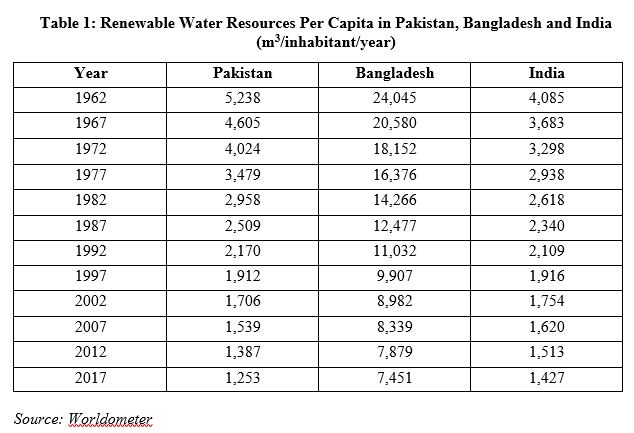
Table 1 presents a comparison of the available renewable water resources per capita in Pakistan, India and Bangladesh. For instance, in 2017, Pakistan had 1,253 m³/person/year renewable water (Worldometer 2022a) while Bangladesh has 7,451 m³/person/year (Worldometer 2022b) and India had 1427 m³/person/year renewable water resources (Worldometer 2022c). This indicates that Pakistan’s available water resources are declining at an alarming rate. Thus, the giant water consumers including both agriculture and industry can enhance water use efficiency by adopting modern and efficient water conservation options to protect Pakistan from becoming a water scarce country.

Pakistan needs to implement significant efforts towards sustainable and integrated water management. Fortunately, development and management of water resources has already received considerable attention. For instance, approval of the first ever National Water Policy Package shows a historic milestone. The policy addresses all relevant issues regarding water resource management and role of relevant stakeholders (Kakakhel 2018). Moreover, Recharge Pakistan is one of the major ventures related to water security and management. It aims to increase water storage and recharge through wetland and floodplain management via community-based natural resource management and nature-based solutions (Recharge Pakistan 2022). Pakistan has also added flood risk mitigation and enhanced water recharge as high priority actions in its updated NDCs (UNFCCC 2021). Pakistan’s updated NCCP focusses on integrated water resource management, capacity building for water management and awareness raising (Ministry of Climate Change 2021).

Pakistan’s textile industry has also shown significant improvement towards sustainable management of water resources, although the efforts need to be enhanced. For instance, Sarena Textiles through its green initiatives has reduced 33.3% water consumption and their average daily water saving is around 1380 m3 (Sarena Textiles 2021). Crescent Bahuman Textiles has set its goals to reduce 50% water consumption via its green initiatives (Crescent Bahuman 2022) and Crestex is aiming to reduce and reuse 25% water as part of its zero liquid discharge goals.

Despite having the world’s largest glaciers, Pakistan is among the world’s 36 most water-stressed countries (Kundi 2017). With the rapidly increasing population, water demand is projected to surpass the supply. This coupled with strained relations with the country’s neighbors over transboundary water resources, the growing water crisis is posing a threat to the country’s future sustainability. The current progress needs to be enhanced and immediate coordinated planning and implementation is required to avert the disaster. In this regard, crucial stakeholders including the textile industry need to efficiently monitor their water withdrawal, usage and pollution patterns keeping in mind international wastewater directives. Moreover, international stakeholders such as top export destinations can support the industry sector enhance its technical capability in water management via trainings and resource allocation. The industry should not rely upon extrinsic pressure to bring sustainable change. It should rather come from intrinsic values and desire for a better change (Hengstmann 2020).

Pakistan and Global Land-Use Change

Land use change is another global environmental challenge posing significant impacts on the natural environment due to human activities. It is the process of transforming the natural landscape, usually associated with the functional value of land for economic activity (Paun and Rashid 2017). In case of Pakistan, the important crops being cultivated include wheat, rice, sugarcane, maize and cotton. Among most vital to the country’s economy are sugarcane and cotton. During 2020-2021, around 12% increase in the cultivated area was observed for sugarcane. Cotton on the other hand was cultivated on 2,079 thousand hectares as compared to last year’s sown area of 2,517 thousand hectares showing a 17% contraction in the cultivated area (figure 4). The factors contributed to this decline are biotic stresses due to pests, abiotic stresses due to climate change and poor agricultural practices. This data indicates that land use patterns in crop cultivation in Pakistan are more associated to the sugarcane farming than cotton cultivation (Government of Pakistan Finance Division 2022).


Figure 4: Cotton and sugarcane production from 2016 to 2021 (Government of Pakistan Finance Division 2022).

Globally, 2.5% of the cultivable land is used to cultivate cotton. However, with the increasing demand of fabrics and changing human lifestyle, land use for cotton production is also increasing. In Pakistan, land use for the textile industry is mainly associated with the cotton cultivation covering 15% of the cultivated area (Ayub Agricultural Research Institute Faisalabad 2022) while in its neighboring country Bangladesh, only around 1% cultivable area is used to grow cotton (Parvez and Ahmed 2021). This indicates that around 0.38% of the global land use for cotton cultivation takes place in Pakistan. Although cotton production has declined in past few years, Pakistan is still among the largest cotton producers globally as it is a naturally more drought resistant crop (Better Cotton 2022a). Thus, if Pakistan aims to increase its cotton production, the associated land-use change impacts need to be given a high priority. For instance, the expansion of cotton cultivation might cause loss of native habitats and exacerbate the spread of invasive species. Moreover, the increasing use of pesticides might cause loss in soil structure and natural carbon sinks (US EPA 2022).

Multiple initiatives around Pakistan have been observed to reduce impacts of land use change associated with the cotton cultivation. For instance, Better Cotton Program launched in 2009 aims to grow cotton more sustainably and improve livelihoods of millions of farmers. As cotton cultivation is getting immensely affected by unpredictable weather patterns due to climate change, this is leading to increased pests thus reducing its production and increasing pesticide use. Better Cotton Program in this regard is supporting farmers to use environmental friendly fertilizers and pesticides and improve water use practices (Better Cotton 2022b). Moreover, Center for Agriculture and Bioscience International (CABI) has implemented its Better Cotton project to train farmers on the Better Cotton Standard System and good agricultural practices. The project aims to reduce pesticide and water use in cotton cultivation, improve yields and ultimately the livelihoods of farmers (CABI 2022a). CABI’s Sustainable Organic Cotton Production project aims to support organic cotton production and contribute to long-term availability of non-GM cotton seeds and organic inputs of farmers with a self-sustaining approach (CABI 2022b). Also, Interloop has initiated its Looptrace platform to allow supply chain stakeholders to track, trace and access transparent raw material information to meet shared sustainability goals (Sourcing Journal 2022).

Pakistan’s textile industry is also committed to enhance cotton cultivation in a sustainable manner and reduce the associated land use change impacts. For instance, Pakistan’s largest textile trade association APTMA (All Pakistan Textile Mills Association) signed agreement with the Better Cotton Initiative (BCI) to boost cotton export with environmental and social compliance (Better Cotton 2014c). APTMA has also hired experts who are working on enhancing cotton production in a sustainable manner. Moreover, ICA (International Cotton Association) has agreed with APTMA to strengthen its support towards cotton needs of the textile industry (Global Village Space 2022).

Climate change has been devastating for Pakistan’s cotton cultivation and textile industry this year. The current country-wide severe flooding and rains have intensified the already declining cotton yield and destroyed more than 45% of country’s cotton crops (Bridge 2022). The global community in this regard needs to come forward to share the burden of their emissions and support Pakistan to enhance its textile exports sustainably.

Conclusion

In conclusion, GHG emissions, increasing water consumption and land use changes are some of the major global environmental challenges associated with Pakistan’s textile industry. Pakistan needs to increase the pace of its monitoring and compliance to overcome these challenges to enhance climate change resilience but also, to stay in line with its regional export competitors. Furthermore, the global community needs to support the current initiatives and assist Pakistan decarbonize its economy. The increasing GHG emissions, deteriorating water quality and quantity and land-use changes in Pakistan need special consideration from both the authorities and the sectors highly reliant on local resources. Textile industry, for instance, needs to monitor its wastewater generation and implement the 3R (reduce – recycle – reuse) techniques. Also, the top textile export destinations can also support the industry in enhancing its technical and financial capability to reduce water consumption and pollution. Additionally, better cotton standards and sustainable initiatives need to be implemented. Pakistan is a top sufferer of climate change. Every time a climate event hits the country, its development is pushed decades back. Thus, Pakistan needs to enhance its social and environmental compliance to make its economic development sustainable and the global community needs to support this development especially in this era of harsh climatic events.

Note:

The data for both cradle-to-gate and gate-to-gate categories, that specifies the contribution of Pakistan’s textile sector towards the above discussed global challenges, is taken from the new ‘Trade and Pollution Dashboard’ (figure 5). This dashboard is initiated by the Sustainable Manufacturing and Environmental Pollution (SMEP) Program by FCDO (Foreign, Commonwealth and Development Office) (UNCTAD 2022).

Figure 5: Trade and Pollution dashboard (UNCTAD 2022).


Regionally-Competitive-Energy-Tariffs-RCET-II-1280x719.png

October 5, 2022

Policy Considerations for Government of Pakistan August 2022

This study, on Regional Competitive Energy Tariffs and Textile Sector Competitiveness (Phase II), conducted between April and July 2022, analyzed the regional competitiveness of the textile industry in Pakistan from the perspective of energy and related issues faced by the members of the All-Pakistan Textile Mills Association (APTMA) though an exhaustive desk research, field surveys, and analyses. The focus of the field work, in June 2022, was on the north and south regions of Punjab—Lahore, Faisalabad, Kasur, Sheikhupura and Multan—and on north Karachi and Lasbella in Sindh and Balochistan respectively. The survey covered all types of textile units in the value chain—spinning, weaving, processing, and composites. This policy note is based on the results of the field and desk study—highlighting the importance of continuing Regionally Competitive Energy Tariffs (RCET) to catalyze the textile exports.

Pakistan has a large untapped potential in the global textile trade, with presently represents just 2 (two) percent of an almost 900bilUSD market! Pakistan’s competitive advantage is embedded in ready-made garments and made ups and exports have been increasing steadily over the last five years. This also highlights the need to improve the upstream ginning, spinning, weaving, and processing value chain efficiencies within Pakistan.

The processing sector consumes almost the entire local pre-processing outputs        Pakistan’s textile exports are concentrated towards USA, China, and Europe; however, the knitwear exports are not only increasing but also heading towards diverse markets. Garments and composites have seen an increase in sales, abroad, post COVID-19—with a relatively higher increase to USA markets; primarily due to lesser Pakistani textile industry downtime during the pandemic.

A common misconception is the burden of industry on the electricity consumption in Pakistan—all industries combined use less electricity (only 26 (twenty-six) percent) than the households (more than 50 (fifty) percent)—in comparison Chinese and Vietnamese industries use 60 (sixty) and 53 (fifty-three) percent, respectively. Similarly, power and fertilizer consume more than 50 (fifty) percent of the national gas supply with while the rest of the industry in Pakistan, including textiles, consumes less (19 (nineteen) percent) than the fertilizer industry alone.

The share of the Captive Power Plants (CPP) used by Pakistan’s exported oriented Textiles industry has been decreasing over time due to these policies—82 (eighty-two) percent of the CCPs in Bangladesh are gas operated while the same percentage in Pakistan is 75 (seventy-five) percent. The story in India is very different—69 (sixty-nine) percent of similar CPPs are coal-fired, while 20 (twenty) percent use furnace oil and only 11 (eleven) percent use gas.

Gas based CPPs in textile sector produce 1300MW of power. Pakistani Textile units have adopted waste retrieval technologies and have replaced old generators with latest ones, thermal and electrical efficiencies have improved and touching 50 (fifty) percent for most of the mills. These CPPs produce electricity with a generation efficiency capacity of 52 (fifty-two) – 60 (sixty) percent against the 25 (twenty-five) – 30 (thirty) percent of the national power plants. Energy cost as share of revenue has decreased owing to the improved energy efficiencies achieved by the textile mills across Pakistan. Despite greater efficiencies, energy costs have a significant share in the final conversion costs of textile mills and these costs cannot be ignored for achieving competitiveness!

Pakistani textiles industry consumes less than 9 percent of the overall national gas supply yet is the first to take the hit on any nationwide gas cuts. This adversely impacts the export sector of Pakistan, being heavily reliant on the textiles industry, as 75 (seventy-five) percent of the textile industry relies on gas-based electricity generation due to its inadequate supply from the national grid. The downstream textiles value chain—processing and composites—rely almost entirely (67 (sixty-seven) to 75 (seventy-five) percent) on gas for their electricity requirements—thus targeting gas cut towards the textiles industry is a direct curb on exports and foreign exchange gains.

Pakistan’s electricity and gas tariffs for the Textiles industry remain the highest in the region—rendering firms uncompetitive—despite the RCET tariffs’ being in play. The general industrial tariff remains at 0.15USD/KWh, twice that in Vietnam and 1.5 times higher than Bangladesh and India. Likewise, Pakistan’s Textiles industry faces highest gas/LNG tariff in the region. Pakistan’s textile industry is paying 9USD/MMBtu, which is 3.5 times more than Uzbekistan, and 1.5 times the Bangladesh’s industrial tariff.

Pakistan’s Textiles industry must price its power inputs at a tariff lower than the regional average tariff of 0.072USD/KWh, to stay regionally competitive. The current RCET for electricity (from the national grid) is higher than the regional average. RCET is an imperative across the whole value-chain, not just for the value-added/exporting elements—if upstream such as spinning firms cannot produce yarn at a competitive rate, processing firms would lose their market competitiveness even with lower energy tariffs.

RCET also attracts further investment by the Textiles Industry of Pakistan. Since 2019, RCETs attracted in new investment of 318milPKR by each composite firm and 153milPKR by each spinning mill.

RCET resultant additional investment generates additional employment in the local Textiles Industry. Implementation of RCET has resulted in on 4 (four) percent increase in employment by textile firms since 2019—on an average, each textile firm employs 2,077 workers—which is significant for a sector that is the second largest employer of the nearly 50mil strong overall workforce, after agriculture.

RCET has shown an increase of nearly 4 (four) percent in output at firm level across the Textiles Industry value chain in Pakistan. The average output value produced by each textile mill is 7.2bilPK, hence RCET resulted in 283milPKR of increased production by each firm—implying 60.3bilPKR increased production.

RCET benefits the firms, employees, and government. The additional investment, employment, and output are not simply benefits accruing to the mills, rather it impacts tax revenues directly for Pakistan as a whole! Increased production means higher revenue generation by government as well.

Tax revenue is only one part of the fiscal equation for Pakistan’s government, for, a 1 (one) percent increase in investment by the textile firms is associated with 7.3 percent rise in exports. On average, the firms[i] export 30milUSD annually and 1 (one) percent increase in investment implies 2.1milUSD of new exports by each firm.

Linking this back to competitive gas tariffs provision by the government of Pakistan, for every 1USD of LNG imported[ii], textile industry creates USD3 of new exports. Subsidy to the textile industry results in forex inflow at significantly lower cost than borrowing forex through Euro and Sukuk bonds

[i] Refers to the firms sampled and surveyed in this present study Regional Competitive Energy Tariffs and Textile Sector Competitiveness (Phase II)

[ii] An estimated 150milUSD of LNG is consumed by the Textiles sector annually, in Pakistan. Uneven—no predictability and lack of availability—supply of grid electricity compounds the efforts to stay competitive! The Textiles value chain is a sophisticated and continuous process, any disruption results in loss of almost complete day of production. An hour of loadshedding results in production losses equivalent to 0.76milPKR and 1.76milPKR for the spinning and the composite mills, respectively.

The 75 (seventy-five) percent of the Textiles mills which are operating primarily on gas based CPPs to compensate for the uneven electricity supply suffer due to gas shortages which get worse in the winter for the northern Textiles manufacturing zone. Average foregone revenue losses amount to 21milPKR/d for spinning and 24milPKR/d for the composite segment due to stoppages in gas supply—the HH sector is given priority in Pakistan so that people can cook ‘naan and roti’!

The Textiles Industry and its value chain have diversified structure of energy demand and require multiple energy source and efficiency options, all of which are being considered and implemented in Pakistan. The green or sustainable energy inputs paradigm too will require a phased approach given the nature of this demand. Pakistani Textile Industry has done well to start adapting and adding multiple fuels—such as biomass and solar—to certain parts of the value chain processes, however a complete switch will require substantial additional investment and time. This is only possible if RCET continues, and the industry continues additional investment. An important footnote here is that the Pakistan Textile Industry may already have a lesser ‘grid emission factor’[i] than the national electricity grid!

Pakistan’s Textile Industry is caught in the cotton-energy-forex triangle; though not alien to other Textiles producing countries, its impact is exacerbated by the mismanagement of the policies within this triangle by the government—often based on misperceptions. The diminishing quality and quantity of local cotton production, the uneven energy supply, and the unpredictable forex costs and availability, need aware management to enable the Pakistan Textile Industry to retain a competitive edge in the global markets. Broad considerations for the government of Pakistan emerging from this RCET II study are as follows.

Entire value chain – The entire Textiles Industry value chain, and not just the direct exporting parts, are equally dependent on RCET, being interdependent and more so as the up-stream value chain has a higher energy demand.

Stable grid electricity – upgrading the existing grid infrastructure and ensuring even (available and predictable) supply to the Textile Industry is key to boosting exports, further investment, creating jobs, and improving productivity.

Restricting new gas and electricity connections – Deterring new entrants and expansion, continued upgrading and job creation and higher outputs for exports through non-provision of new electricity and gas connection directly retards economic growth of Pakistan.

Output growth is the road to modernization—higher energy and process efficiencies and higher output – Correct policies by the government of Pakistan in the recent past have shown that RCET and supporting policies to enable the Textiles Industry to stay competitive has led to significant growth in exports, revenues, output, employment, and investment. The path to further modernization and technological advancement and environmental sustainability of Pakistan’s Textiles Industry lies in supporting its regional competitiveness.

PKR devaluation is not a panacea – A devalued PKR while rendering small parts of the Textiles value chain competitive, render most of it uncompetitive. Raw cotton in Pakistan is consistently degrading in quality, and its overall production is also declining, and the Textiles Industry must import cotton. A major part of the national energy, whether gas or electricity, is imported. Both form a substantial part of the input costs and are immediately impacted by PKR devaluation

1- Refers to the firms sampled and surveyed in this present study Regional Competitive Energy Tariffs and Textile Sector Competitiveness (Phase II)

2-  An estimated 150milUSD of LNG is consumed by the Textiles sector annually, in Pakistan.

3-  A “grid emission factor” refers to a CO2 emission factor (tCO2/MWh) which will be associated with each unit of electricity provided by an electricity system. It is a parameter to determine the baseline emissions for CDM projects in the renewable energy sector (hydro, wind, solar PV, and geothermal power, etc.).

https://www.iges.or.jp/en/pub/list-grid-emission-factor/en


LOCATIONS

Where We Are


GET IN TOUCH

Follow Our Activity


IslamabadKarachiLahore