Press Release
12th September 2022
A delegation of All Pakistan Textile Mills Association (APTMA), led by the Patron-in-Chief Dr. Gohar Ejaz, and senior members Mr. Fawad Mukhtar and Mr. Anwaar Ghani, has left for Tanzania, for sourcing Cotton for Pakistan to fulfill future requirements of cotton in the wake of the destruction caused by the flood in the cotton-growing areas.
Pakistan has been hit by the worst floods in its history, affecting 33 million people and incurring an estimated cost of more than $10 billion of infrastructural damage. According to the latest reports, economic losses and damages caused by the flash floods could range from $15 billion to $20 billion, as the government fears up to 12 million more people will slip into poverty.
The floods have also affected the Cotton crop severely. The current estimates of Cotton losses are 3.5 million bales which are 36% of the crop that was expected this year and the loss is valued at US$1.5 billion.
Pertinent to mention that close to 70 percent of Pakistan’s textile industry, an important source of employment and foreign exchange, uses the cotton produced in the country. Since nearly 35 percent of that is produced in Sindh province by farmers, the sector is girding itself for a shortage.

The flood has made it terribly difficult for the government to reduce its trade deficit targets because while the country needs to import food to “compensate” for lost crops, the textile sector finds itself struggling due to a potential shortage of cotton crops. Cotton prices in Pakistan have already surged sharply over the past few days.
Therefore, Pakistan has to arrange this Cotton at the lowest cost possible on an emergency basis for the sector to continue meeting the export orders. Any delay / non-delivery of export orders will further worsen our ‘Balance of Payments’ which is already under extreme pressure and the industry will lose hard-earned international clients.

Dr. Gohar Ejaz
Pakistan’s textile industry is on an upward trajectory with the addition of $500 million per month through incremental capacity. This has been enabled through TERF and its support of 100 new projects. However, even the current capacity is not fully utilized due to energy supply and quality constraints for the last 6 months, costing Pakistan approximately $300 in lost production/exports million per month.
The global apparel market is expected to grow to $843.13 billion in 2026 at a compound annual growth rate (CAGR) of 8.6%, but Pakistan’s textile industry has not captured a sufficient level of this demand, given its potential and existing capacity to add $10 billion per annum to exports. The textile industry is faced with countless opportunities to capture greater market share, but state reforms in energy, technological upgradation, diversification and value addition will be necessary in order to enhance the potential of the sector and facilitate economic growth at unprecedented levels. It is pertinent to note Pakistani exporters’ exemplary handling of disruptions such as the COVID-19 pandemic and its greater performance compared to regional competitor Bangladesh.

To maintain the current momentum, the textile sector has committed to unprecedented value addition by committing to set up 1000 garment plants. Each plant will consist of 500 stitching machines at an investment of $7 million; able to produce garments for exports of $20 million per annum, while generating employment for 700 workers. The total investment would be US $7 billion generating annual exports of $20 billion and providing employment to well over 700,000 workers. A thousand garment plants are being established near major textile producing cities.
This commitment is reliant upon strong and sustained policy support. Despite having been acknowledged as the backbone of the economy since early on, the textile sector has suffered through a period of weak policy support over the years. In order to grow at scale and achieve its target of $50 billion in exports over the next 4 years, the textile sector requires:
- Adequate supply of energy at regionally competitive tariffs
- Availability of working capital
- 500 new entrepreneurs
- TERF like facility for Rs 500 billion ($ 2 billion) to facilitate investment.
- Debt Equity ratio of 80:20 which includes building & infrastructure as 50 % of cost of garment factories is on these items.
It is important to note that the textile sector has had its order books full for the past few years, despite the countless setbacks due to external challenges – inflation, high interest rates, the war in Ukraine, lockdowns and technological change. By identifying key setbacks and garnering policy support and facilitation from the government at unprecedented levels, the sector emerged successful in meeting a majority of the demand, increasing its output and improving its logistics network. These results have been tangible and had a great bearing on the economic growth projection for the coming year.

The ready-made garments industry has emerged as one of the most important small-scale industries in Pakistan, with sizeable demand both at home and abroad. In terms of quality, Pakistan’s products can greatly benefit from technological upgradation. Advancements in equipment and e-manufacturing can exponentially improve our exports and facilitate an entry into high performance apparel and MMF. This will also allow the sector to meet its needs in terms of value addition and diversification of the export bundle.
Pakistan is the 4th largest producer and 3rd largest consumer of cotton worldwide. However, this major sector is faced with frequent hurdles such as import restrictions on critical inputs, and long delays in the approval of import permits. Meanwhile, most South Asian economies have optimized their production of goods and services in which they have competitive advantage, and further diversified their export baskets to enter an abundance of untapped markets. They have also tapped into high-tech, high-value-added products. The demand for MMF-based apparel has grown exponentially, owing to the convenience it affords. However, cotton and textiles in Pakistan suffer from a lack of quality research and application. We must reduce the focus on primary commodities, and make the much overdue shift towards secondary and tertiary sectors – manufactured, nontraditional goods and value added services.
With that said, the textile sector is highly sensitive to energy outages and quality, so given Pakistan’s troubled energy sector, these matters ballooned into a large-scale hindrance in its growth and made it difficult to meet costs, let alone achieve much needed revenue targets that could allow for modernization and expansion. A long term Energy Tariff Policy with clear billing mechanism is an essential component to be ensured moving forward, so that the performance of textile sector can be rid of the problems created by an unstable and uncompetitive energy supply.
In addition to this, issues of grid connected electricity, quality, transmission and availability, and an expensive energy mix abound. The exporting industry cannot pass on incidentals of taxation & institutional inefficiencies to international buyers. 5-7% of incidences of various local provincials & Federal Taxes are not zero rated on exports. The rising circular debt is a direct result of the non-resolution of these long-standing issues.
More specific issues to be addressed include working capital requirements. In FY22, the total amount retained by FBR as sales tax on domestic sales was Rs 50 billion out of Rs 249 billion collected. Over Rs 250 billion liquidity of the industry remains with the FBR at all times as a result of this collection and refund mechanism. Sales tax is on a consumption basis which inflates inventory and capital costs, serving as an impediment to new projects as capital cost increases by 20 percent and refund can only happen after commercial operations. Furthermore, there are numerous technical errors and inefficiencies in the sales tax refund FASTER system of FBR that require immediate rectification.
According to a report by the IMF, the cascading effect of GST has harmed Pakistani exporters’ competitiveness as there is currently no systemic method to ensure that all tax paid on inputs may be charged against a final sale is refunded. This huge cycle of sales tax collection and refunds, exporters suffer in the form of delayed pending and deferred refunds. The cost of collecting and refunding sales tax outweighs the revenue collected by a significant margin.
Competing textile economies have opened up their markets, thereby securing major market shares. Following this strategy, Pakistan must formulate its trade policies with a view towards increasing market access, on a reciprocal basis whereby Pakistan’s market openness would also have to increase. There must be a dedicated effort to promote private investment in the industry, which is naturally contingent upon interest rate support, as well as a reputation for never compromising on quality.
Export-oriented industries in Pakistan are at least 25 percent more productive than non-export oriented businesses, and their productivity increases with an increase in economic activity as well as greater foreign exposure and alliances. However, systemic inefficiencies cannot be exported, so these must be mitigated from all inputs before results can be seen. Since exports in Pakistan are labor-intensive, expansion in this industry is a surefire way to ensure large-scale job-creation, as well as an increase in foreign currency to pay for required imports. The problem has not been a lack of policy development, but rather the implementation of policies to mitigate the disadvantages that have persisted over the years. With a greater focus on implementation of policy, there can be a tangible impact in terms of sustainable development and economic growth, greatly enhancing the position of the textile industry and Pakistan’s exports in the next 4 years.
Shahid Sattar and Eman Ahmed
Amid elevated levels of inflation, the war in Ukraine, and rising interest rates, global economic growth is expected to be weak in 2022 and 2023. The war has resulted in elevated prices of food and energy, and the situation is increasingly dire. Being an oil importing country, Pakistan heavily relies on hard currency to finance imports, and is thus faced with mounting food and energy prices and deteriorating external balances.
Central banks across the world have been raising interest rates to tame inflation, but this monetary policy fails to account for supply shock disruptions. Pakistan’s interest rate remains elevated at 15%, thereby hurting businesses and stifling investment and entrepreneurship. The annual inflation rate increased to 24.9% in July 2022, the Pakistan Bureau of Statistics reported.
Pakistan’s interest rate has intentionally been maintained at a high level in miscalculated attempts to control inflation, by means of a contractionary monetary policy. Although policies of this nature have been effective in reducing inflation for certain Highly Developed Economies, there is no evidence to suggest the same rules apply to the case of Pakistan. On the contrary, it is proven that a high interest rate in Pakistan leads to an increase in cost-push inflation. This belief was echoed by Nobel laureate economist Joseph Stiglitz, who recently described how within the US economy and others possessing market power, companies can afford to raise prices without losing business. Meanwhile, standard economic models suffer from even more inflation when subjected to rate hikes.
Contractionary monetary policy operates by decreasing the money supply in order to increase the cost of borrowing. This measure normally decreases GDP and dampens inflation. The State Bank chose to maintain a high interest rate, decreasing the money supply in attempts to curtail inflation. However, the opposite impact has been observed in Pakistan’s case, as here there is a directly proportional relationship between inflation and discount rate.
Former federal minister for finance Dr. Hafiz Pasha has said that focusing on export-led growth, increase in tax-to-GDP ratio, revenue collection from the untaxed and a crash programme for the loss-making state owned enterprises are a must to get rid of the economic challenges being faced by the country. He added that in the absence of FDI, if the government decides to issue bonds, it would have to issue at 22 percent interest rate, which, of course, would be untenable.
Though Pakistan is a resource-rich country, its economic condition is deteriorating, and Dr. Pasha fears that the country’s foreign exchange reserves could go down below $7 billion before receiving money from the IMF. He opined that a safe level is $18-19 billion.
Public debt in July was around Rs50 trillion while the external debt-to-GDP ratio reached 41%. Five years ago, external loans stood at $83 billion, which are $130 billion today. “It is a matter of concern that we do not have foreign exchange reserves at the beginning of the financial year.”
Investopedia defines stagflation as “the simultaneous appearance in an economy of slow growth, high unemployment, and rising prices.” In Pakistan, growth is expected to moderate from 5.7 percent in FY2020/21 to 4.0 percent in 2022/23 as foreign demand slows significantly and policy support is withdrawn to contain external and fiscal imbalances. (World Bank) The annual inflation rate in Pakistan increased to 24.9% in July of 2022, the highest since October of 2008, amid a slide in the rupee to record lows. Furthermore, according to PIDE, over 31% of Pakistan’s youth are currently unemployed, out of which 51% are females, 16% are males, and many of whom hold professional degrees.

Inflation in Pakistan
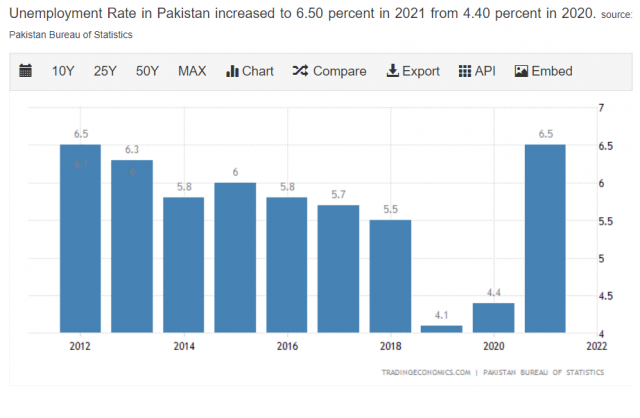 Unemployment Rate in Pakistan
For a country like Pakistan where the major export is textiles, the economy largely relies upon low-value and geopolitically insignificant products. Investment in machinery for value addition is also stagnating in the face of present economic turmoil. To strengthen the trade value of a small economy like Pakistan, there is a need for enhanced trade openness. This necessitates the identification of efficient trade routes and diverse networks of supply chains to ensure smooth flows of goods and materials. It requires tighter integration and communication between supply networks which should be coordinated between both public and private sectors.
However, these matters have been further aggravated due to the State Bank’s failure to approve critical imports of textile mills in a timely manner. Payments for essential inputs are not being approved due to unnecessarily bureaucratic procedures and delays at the provincial level. These delays pertain to imported machinery parts which are regular inputs for textile machines – essentially required to run and maintain spinning and weaving machines. The situation is dire, as without timely supply of spare parts to the machines, production is halted indefinitely. This is leading to massive and unrecoverable losses of exports, and further restricting economic growth.
Meanwhile, MENA oil exporting countries are forecast to witness their highest growth rates in 2022 (Figure 5). This is primarily due to higher oil prices and almost complete recovery from the pandemic due to residents’ high vaccination rates. However, higher oil prices may slow down the urgency of the past ten years to: (i) transition to renewable energy sources; (ii) diversify the economy away from oil; (iii) reduce the role of the public sector in the economy. (Whiteshield)
Moreover, industries in Pakistan are energy intensive and will therefore see rising input costs of energy, other commodities and borrowing. With interest rates being synchronized with the US Fed policy interest rates, borrowing and servicing debt costs are expected to rise. Furthermore, the strengthening value of the US dollar has been constricting the textile industry’s liquidity and eroding competitiveness.
In this high-risk scenario, it is recommended that stress tests and policy assessments be undertaken at the highest levels of government. “The over-riding objective is to forge crisis-specific resilience and stabilization plans that help developing countries wither the gathering global economic storm.” (Whiteshiled) An export-led economic growth model is central to strengthening these economies, but this also requires a more diversified product basket and diversified markets. The major exports of textiles need to be supported for value addition while simultaneously tapping into other products and services. This is more sustainable than acquiring more foreign aid.
Higher value addition through technology, IT investment and renewable energy generation are the most impactful and symbiotic means to improve the economy while simultaneously enhancing worker capabilities and enabling integration into Global Value Chains. Enhancing internal capacity in these industries will allow is to reduce imports. Pakistan’s import bill has historically been weighed down the most by petroleum imports; therefore, drives for domestic exploration of renewable energy sources must be introduced, and the transition to solar and wind capacity must be pursued aggressively, which will have positive impacts on job creation and skill enhancement for the population.
If we target the doubling of Pakistan’s trade value by 2030, there is a need for aggressive export facilitation by the government by incentivizing exports and reducing tariffs for the most productive and high potential exporting industries, and by reviewing non-tariff barriers to trade and ensuring international standard compliance. The country should engage professional consultants to lobby for GSP+ status for Pakistan. With our competitive advantage in textiles, Pakistan should be able to target 10-15 leading brands and retail chains in the USA and Europe for sourcing Textile & Clothing from Pakistan.
It is often argued that giving priority and subsidies to exporters will lead to neglect of other industries and businesses such as local startups. However, this is the most effective geo-economics strategy for a country like Pakistan that struggles to in forex through other sustainable means, so these measures are critical for the long-term stability of the economy. Another strategic implication to bear in mind is that reducing oil imports may result in energy shortages if domestic production is not able to keep pace. Since exports are to be supported on a priority basis, this may lead to power cuts for domestic consumers and industries that are less productive, resulting in energy insecurity in the short term. However, the strategy of prioritizing domestic energy is not geo-economically prudent and is more often applied for political gain e.g. to secure votes.
The textile industry has definite advantages for Pakistan’s economy – it is labor intensive, easy to set up and expand, has low skill requirements using simple machines and processes. There is a high demand, a large market and fast profits. Furthermore, it supports many advanced derivative industries including dyeing, chemicals and design. It is therefore a gateway industry into making an economy capital-rich and possibly geo-economically significant. However, value addition and progress are the ultimate goal for economic growth. Strengthening domestic production of energy, hi-tech, finance, media and communications, strategic materials and healthcare are what make a strong and powerful economy. To achieve this, we must reduce the high government footprint in Pakistan’s economy, as it limits ability for private businesses and free market forces to enable growth and diversification, and we fall prey to a boom-and-bust cycle where short and stunted growth cycles are followed by periods of stagnation, particularly vulnerable to global shocks and disruptions.

Shahid Sattar and Amna Arooj
The exchange rate is a crucial component of trade and a dynamic macroeconomic determinant. The trade balance is impacted by exchange rate fluctuations. The growth process is slowed down as a result of unstable exchange rates since they have an impact on capital flows, slow down commerce, and undermine investor confidence. The evaluation of investment operations, hedging, and financing, as well as the reduction of operational risks, are all aided by a stable exchange rate for financial institutions and businesses.
The evolving economic dynamics have changed the world economy and caused numerous difficulties in recent years. This includes rising food prices, inflation, and oil prices. Like many developing countries, Pakistan has also faced backlash because of the international changes as well as national developments such as political instability. Galati and Ho (2003) assert that changes in the news have a significant impact on currency rates. They investigated the idea that any good or positive news raises the value of a currency, but bad news causes it to decline. This has been recently witnessed in terms of the ever developing political instability in Pakistan.
The exchange rate has a two-way relationship with the exports and imports inter alia. The relationship works both ways whereby the fluctuating rate affects the exports and imports, similarly the fluctuating imports and exports affect the exchange rate. In addition to exports and imports, there are other macroeconomic factors that influence the exchange rate. These include interest rates, the current account balance, and the national debt.
The central bank controls the interest rates in an attempt to manage the exchange rates. Foreign investors prefer investing in countries with high interest rates because they can earn greater returns than in other nations. If the interest rate is higher, foreign capital will be drawn in, which will raise the exchange rate. If a country’s current account is in the red, foreign capital is borrowed to close the gap. Local currency loses value due to excessive foreign currency demand.
Moreover, the interest rate in Pakistan was increased by 125 basis points to 15% in July 2022 – following a 13-year peak in inflation, the rate was raised from 13.75 percent. Consequently, this is causing detrimental effects on the fuel cost as well as the inflation. Despite having a high interest rate (15%) in Pakistan, exchange rate devaluation isn’t in control; although the detrimental effects of high interest rate are quite visible in the form of lower investments, absence of progression in almost all industries among others. This calls for a spontaneous, long-term strategic action from the government side at large to bring back the economy on track by lowering the interest rate.
Pakistan has been under the grip of debilitating exchange rate for quite a time now. In the midst of escalating political unrest and economic difficulties, Pakistan’s currency hit a new low against the US dollar, shattering all previous records. The interbank closing rate of one dollar on 1st August 2022 was 238.84 Pakistani rupees.
Pakistan’s current account deficit (CAD) increased significantly during the course of 11 months (July to May) in 2021/2022, according to the State Bank of Pakistan (SBP). According to data from the balance of payments (BoP), the current account deficit in the equivalent months of the previous fiscal year was $1.18 billion. The enormous trade imbalance caused by the sharp rise in import costs may be to blame for the current account deficit’s massive growth. According to figures issued by the Pakistan Bureau of Statistics, the country’s trade deficit jumped by 58.18% to $43.42 billion between July and May 2021/2022 compared to $27.45 billion during the same period of the previous fiscal year (PBS). Comparing the first 11 months of the current fiscal year to the same months of the previous fiscal year, the country’s import bill increased by 44.51 percent to $72.29 billion. However, export revenues also increased by 28% to $28.87 billion during the reviewed period from $22.57 billion during the same time of the previous fiscal year.

Source: Ministry of Commerce
The increase in export revenue is primarily because of the performance of the textile sector in Pakistan. With exports rising from $12.5 billion just two years ago to nearly $20 billion now, the textile industry has set a new record. The implementation of the Regionally Competitive Energy Tariff (RCET), investments totaling more than $5 billion in development, and the establishment of 100 new textile facilities, which resulted in an increased export capacity of $500 million per month, all contributed to this tremendous boom. This doesn’t stop here, the sector has a potential to deliver $2 billion/month worth of exports, if provided with conducive environment.
In the upcoming fiscal year, textile exports are anticipated to reach $25 billion or more subject to energy availability at competitive rates. However, Pakistan will be obliged to look for additional $6 billion in loans from overseas, which under the current economic conditions would not even be doable, if this export momentum is lost owing to problems with energy supplies, cost restraints, and a crippling exchange rate.
In the longer run, the large devaluation of the rupee is worse for exporters especially textile exporters because it raises input costs, making exports less competitive. One of the biggest difficulties the sector faces is finding a steady supply of high-quality raw materials at reasonable rates.
Additionally, circumstances have developed that have caused Pakistan’s textile sectors’ inputs, just like all of its other exporting sectors’ inputs to be measured in dollars in order to reduce the risks associated with currency volatility and to create a stable and secure environment for business. This includes raw materials, energy, dyes and chemicals, machinery, and spare parts, inter alia. Simply said, a country’s exports become less expensive and its imports become more expensive as its currency depreciates. However, in a globalized economy, industries are vertically linked, and exported goods often contain a significant amount of imported components. Therefore, imported inputs become more expensive for any given exporter and are not always interchangeable with domestically produced goods.
Aftab and Abbas (2012) concluded that exchange rate instability has significant negative relationship with sectoral export of Pakistan except waxes and animal oils, aircraft, transport equipment and arms. A negative indication indicates that a rise in relative price is to blame for the decline in export demand. Their study also implied that the textile and textile articles showed a negative sign. Arize et al. (2003) also concluded in his study that in both the short- and long-term, an increase in exchange rate volatility has a considerable negative impact on export demand.
Equally important is the fact that Exports rise in response to (real) currency depreciations and decline in response to (real) currency appreciations. This might not always be the case, though. Over a two-year period, a gain in exports of 4.9 percent results from a real devaluation of 10%. However, exporters adjust to the “new normal” just one-third as quickly after a depreciation as they do after an appreciation. Exports decrease more quickly following (real) appreciations than they do following depreciations because of supply limitations, pricing to market, and informational frictions (Varela, 2022).
After the rupee’s fall in 2018–19, Pakistani textile and apparel exporters did not increase export volumes. The primary explanation for this is that changes in profit margins stabilize export prices in the local currency, and this effect is accentuated during depreciations: US dollar export prices react to fluctuations in the nominal exchange rate by 15% more than they do during appreciations. The more the exchange rate changes, the more asymmetrically export US dollar prices respond, demonstrating that purchasers level out Pakistani rupee pricing.
If we look at Pakistan’s experience with rupee depreciation, we can say that it has always resulted in cost-driven inflation and relentlessly harsh economic conditions. Pakistan has suffered significantly from currency devaluation both as a buyer and a seller. Devaluation of the Pakistani rupee will result in a devaluation of Pakistani labor and talent on the global market, which will act more as a stimulant than a medicine and lead to unheard-of inflation.
It is time to abandon the widespread misconception that exporters welcome rupee devaluation and end the practice of favoring excessively undervalued currencies. The central bank and government should concentrate on achieving an exchange rate that is competitive in the market and achieves actual exchange parity. The policymakers should create the right conditions for a maximal export response to currency depreciations. This will enable a conducive environment for not only exporters in general but also the economy. There has been no concrete step taken so far by the government to put a halt to the ever depreciating Pakistani currency. Moreover, given present situation, we are not in any position to raise bonds and have no access to capital markets anymore. This is of grave concern.
The Pakistani government must support the exporters in their efforts to get ready for the impending challenge by keeping up with the evolving economic situation. It needs to support the export drive as the dollars earned through exports are the cheapest, more sustainable with the added benefit of no compulsion to return them, no interest, and still the cheapest with only 3-4% cost. Hence, focusing upon dollars generated through exports are far better option than bonds. Pakistan has to make a quantum jump, but even if it manages to improve its export performance through textiles, it may have a better chance of holding onto and eventually expanding sustainable, export-derived, dollarized revenue.

Press Release
29th July 2022
Rahim Nasir
Pakistan is currently on the brink of economic collapse. With depleting foreign currency reserves, rising inflation, the exchange rate in free-fall and irrationally high interest rates, the country is headed towards a path similar to the economic downfall of Sri Lanka.
We at APTMA are pushing for all leaders and policymakers to develop a consensus on how to navigate from this situation of extreme distress and pull the economy out of this downward spiral. We recommend the following key areas for reform.
The first is political stability. A lack of political stability is a serious impediment to economic progress. Not only does it shorten policymakers’ horizons leading to suboptimal short term macroeconomic policies, but it is also the cause of frequent policy U-turns and leads to non-completion of ongoing projects. Stability and consistent policy implementation are crucial for economic growth and for the export sector to thrive and contribute dollar earnings to stabilize the Balance of Payments for a sustainable economic outlook.
The exchange rate is a major cause for concern. The ER instability has significant negative relationship with sectoral exports of Pakistan such as textile. A negative indication indicates that a rise in relative price is to blame for the decline in export demand. Pakistan has been under the grip of debilitating ER for quite some time now. The value of one dollar reached its highest point ever on 27th July 2022 when it hovered at around 237 Pakistani rupees. In the long run, the large devaluation of the rupee is worst for exporters especially textile exporters because it raises input costs, making exports less competitive.
It is time to abandon the widespread misconception that exporters welcome rupee devaluation. The central bank and government should concentrate on achieving an ER that is competitive in the market and achieves actual exchange parity. Dollars earned through exports are the most sustainable with the added benefit of no compulsion to return them, no interest, and the cheapest with only 3-4% cost. Hence, focusing upon dollars generated through exports are far better option than bonds.
Moreover, the need for a long-term policy featuring lower interest rates cannot be underestimated, and its implications for a brighter economic future which generates foreign currency, jobs and international recognition cannot be denied. We need more investments in Pakistan, alongside holistic policy reforms that lend confidence to investors and the markets. This need cannot be met with an interest rate of 15%.
Roadblocks to entrepreneurship and innovation need to be mitigated so that we can empower our youth and our disenfranchised talent to bring about a grassroots level economic revolution. We must rid our policymaking of the economic formula whereby interest rates are raised in order to stabilize the economy, as this can only be effective in certain Highly Developed Economies: a title which Pakistan’s economy is a long way off from attaining. The best mechanism is through supply-side interventions, bringing more individuals into the economy and increasing the labor supply – for which entrepreneurship and financial inclusion is critical.
The current account deficit increased by 517 percent in FY22 compared to FY21. To counter the dangers of our mounting debt, we must immediately take the following steps:
- Reduce the import bill by at least $ 5 billion, especially energy’s, through ensuring energy efficiency.
- Shockingly, petroleum imports increased by 50% in June 2022 in volume terms. Pakistan imported petroleum products worth $24 billion last year. Gas needs to be used for productive purposes only. At present gas is being supplied to ceramics, steel and glass also.
- Declare an energy emergency and introduce measures to conserve energy which can save Pakistan’s economy in more ways than one:
- Aggressive conservation – cuts import bills by more than 25% & saves $6 Bn.
- Implement both Price & Administrative measures to curtail consumption.
- Curtail domestic gas supply to reduce consumption & waste by 18% UFG.
- Single point Energy supply to Domestic Gas.
- Fast track calibration of cooking burners to save 200 MMCFD of Gas/RLNG.
- Improve documentation and inclusion of unbanked persons
- Reduce external pressure ‘hawala’ from $10 to $5 billion by documentation as hawala can survive on undocumented sector only; introduce scheme whereby State Bank of Pakistan opens up bank accounts for those currently having no account with a pre-approved overdraft facility of PKR 10,000 that can be used as seed money for entrepreneurship.
- Revamp and improve the export paradigm by ensuring competitive tariffs and improved facilitation.
Furthermore, we must take steps to add value in our exports and thereby improve global perceptions of Pakistan. This would require an environment that facilitates exporting industries to focus on quality improvement through new processes, thereby developing new products and entering fresh markets.
With a myopic focus on short staple fiber raw cotton, we rely on a shrinking market while neglecting the rapidly expanding market for MMF. The MMF tariff regime effectively prevents Pakistan from aligning its products in tandem with the rest of the world. The duty protection given to obsolete plants in Pakistan is denying the Pakistani industry any chance to compete in this booming market, internationally or domestically. We must do away with such hurdles so that progress can be made in value addition, diversification and market expansion.
Lastly, leaders must prioritize export-led economic growth. Enhanced exports enable the inflow of foreign currency to finance imports, service debt, stabilize exchange rates and to overcome the persistent problem of the balance of payment deficit.
The textile sector has performed exceptionally well in the last 2 years. Textile exports have increased by 43 percent in FY22 as compared to FY18. Textile industry has invested a sum of $5 billion over the past few years in new plant & machinery and upgradation. Further expansion and increase in exports are limited by the inconsistent availability of energy at Regionally Competitive Energy Tariffs (RCET). Given that the past export spur occurred due to the priority of the government to provide regionally competitive terms for the sector, this policy must be consistently maintained in the future to enable economic stability and subsequent growth.

Gohar Ejaz, Shahid Sattar and Eman Ahmed
The majority of people in developing economies do not have bank accounts, creating an inequitable economic world that impacts the individual’s social and economic well-being (Donner and Tellez, 2008; Duncombe and Boateng, 2009). Financial inclusion in Pakistan is rudimentary compared to other countries that follow export-led growth models. The country’s regional competitors have performed better in most areas pertaining to access to finance.
Pakistan, a developing country with a population exceeding 220 million, boasts a high mobile phone penetration of 73% (Pakistan Economic Survey, 2014/15). However, 88% of the total population is unbanked and financially marginalized, out of which 63% of the population resides in rural communities (World Bank, 2014). There is consensus amongst policy-makers to increase financial access through financially inclusive banking practices (Anwar, 2013).
In addition to financial exclusion, there are other roadblocks to entrepreneurship and innovation that need to be mitigated so that we can empower our youth and our disenfranchised talent to bring about a grassroots level economic revolution. We must rid our policymaking of the economic formula whereby interest rates are raised in order to stabilize the economy, as this can only be effective in certain Highly Developed Economies: a title which Pakistan’s economy is a long way off from attaining. HDEs tend to have surplus currency tied up in mortgages or consumer financing. Therefore, it is only logical that such a formula be limited in its application to those economies which are in a similar state, while a policy more suited to developing economies should be used in Pakistan’s case. The best mechanism is through supply-side interventions, bringing more individuals into the economy and increasing the labor supply – for which entrepreneurship and financial inclusion is critical.
High interest rates belie the impression of a stable economy in the short run, while long-term economic health continues to be endangered due to the volatile nature of an economy with an interest rate as high as 15%. Furthermore, high interest rates not only curtail investment, but also make it virtually impossible for the concerned industries to remain profitable. The spike in interest rates has all but put a complete stop to investment, upgradation and technological advancement in various industries. Pakistan’s interest rate is now the highest in the region – even higher than that of Sri Lanka, which is reeling from a default on its debt.
| Country | Interest Rate % (July 2022) |
| Pakistan | 15 |
| Sri Lanka | 14.5 |
| Bangladesh | 5 |
| India | 4.9 |
| Vietnam | 4 |
Source: tradingeconomics.com
Subsequently, the low level of investment has worsened the state of affairs, particularly for productive sectors which are now struggling to maintain productivity and. The abrupt rise in factory shutdowns and closing of textile businesses are causes for concern. The cost of doing business increases indefinitely with the rise in interest rate, which also implies hindrances in access to capital, leaving businesses to fend for themselves and struggle to make ends meet with no fallback option. Investors are also less likely to put money into active projects as the high interest makes these options volatile and high-risk.
All these factors result in a spillover effect with mass downsizing, stifled economic activity and stagnation in GDP growth. Thus, it comes as no surprise that technological advancement is rendered a distant fantasy for an industry facing an economic crisis.
A more adaptive financial model and a focus on more productive capital investments, particularly in technology, will have a wide, far-reaching impact that will bear fruits for generations to come. It will allow for a much-needed increase in our presently abysmal level of exports, and will also tackle the increasing burden of unemployment at the root.
When a bank account is opened, it’s a step towards joining the economic mainstream. It is a sustainable mechanism to fast-track grassroots entrepreneurship, innovation and economic stimulus from the bottom up. With financial inclusion as the ultimate goal, Pakistan’s government should follow in the footsteps of Modi’s PMJDY, whereby the State Bank of Pakistan opens up accounts with a pre-approved overdraft facility of PKR 10,000 that can be used as seed money for entrepreneurship. It is proposed that the State Bank may also provide overdraft facility and debt moratorium for those unable to repay the loan in time.
In order for Pakistanis to be eligible for this scheme they must currently have no bank account. The only document required to be presented when opening the account should be the individual’s CNIC, verifiable through NADRA biometric. As for cases of overdraft, interest can be charged on the PKR 10,000 amount. However, in case of default, the government should step in to cover the amount. If this scheme is successful, an estimated 50 million accounts will be opened, with a potential disbursement of PKR 500 billion. The current scenario wherein charges are applied to accounts with balances below a certain minimum is detrimental to efforts for financial inclusion, so this scheme will be free of any such charges.
Investing PKR 500 billion into the people of Pakistan who are currently unbanked and at the lowest rung of the economic ladder, is bound to have a multiplier effect on the economy, simultaneously enhancing opportunities for employment, entrepreneurship, value addition, education, gender parity and effective resource allocation for economic growth – enabling a sustainable exit from the path of recession upon which the country is currently treading.
The impetus behind this proposal is the success of India’s revolutionary banking scheme, which continues to improve financial inclusion even now. In 2014 Indian Prime Minister Narendra Modi launched a plan to provide a bank account for every household, in a landmark initiative to help the poor. (BBC) Pradhan Mantri Jan-Dhan Yojana (PMJDY) is India’s National Mission for Financial Inclusion to ensure access to financial services, namely, a basic savings & deposit account, to access remittance, credit, insurance, pension in an affordable manner. Under the scheme, a basic savings bank deposit account can be opened in any bank branch by persons not having any other account. Under the banking scheme, account holders receive a debit card and accident insurance cover of up to 100,000 rupees ($1,654; £996). They also get an overdraft facility of up to 5,000 Indian rupees.
Benefits under PMJDY:
- One basic savings bank account is opened for unbanked person.
- There is no requirement to maintain any minimum balance in PMJDY accounts.
- Interest is earned on the deposit in PMJDY accounts.
- Rupay Debit card is provided to PMJDY account holder.
- Accident Insurance Cover of Rs.1 lac (enhanced to Rs. 2 lac to new PMJDY accounts opened after 28.8.2018) is available with RuPay card issued to the PMJDY account holders.
- An overdraft (OD) facility up to Rs. 10,000 to eligible account holders is available.
As per latest government data, PMJDY now has 42.89 crore beneficiaries (basic bank account holders) with ₹1,43,834 crores total balance. More than half of the beneficiaries are women (23.76 crore) while 28.57 crore are from rural and semi urban areas.
A senior official of State Bank of India said the average balance in the accounts which is hovering around ₹3,000-3,500 across banks is ‘an indication’ that the scheme has now become a channel for savings for the low income families. The Global Findex data base of the World Bank has also shown ‘substantial’ increase in financial inclusion in the country after 2014. As per the index, 80 per cent of people above 15 years of age in the lower-middle income group have a bank account now compared to 53 per cent in 2014.
Morawczynski et al. (2010) argues that financial inclusion success should not only be limited to the withdrawal of payments from bank accounts. The term should also incorporate the usage of accounts for undertaking economic activities. Therefore, ‘full financial inclusion’ entails participating in a wide spectrum of financial transactions, such as depositing savings, accessing credit/insurance and making payments in the banking sector (Ehrbeck, 2011; Bold, Porteous and Rotman, 2012).
Meanwhile in Pakistan, penetration in the financial sector is extremely low, with only 2.4% of the population having access to credit from formal financial sources. Out of the total adult population of Pakistan, the financially excluded population make up 53%.
Although financial inclusion is usually categorized as access to formal financial services, in developing countries including Pakistan, a significant proportion of people prefer and have access to informal finance. Informal access can occur through the organized sector (though committees, shopkeepers, moneylenders etc), or through friends and family. An estimated 19 percent have voluntarily excluded themselves through lack of understanding or need, due to preference, poverty or religious reasons.
BISP holds the largest database of underprivileged families in Pakistan – recorded by the National Database and Registration Authority (NADRA) after conducting the largest and first ever door-to-door poverty survey. Since we seek to propose a similar scheme, it is important to analyze the benefits and constraints of BISP so that we are able to utilize an upgraded version of a tried and tested model for Pakistan. Dr. Atika Kemal’s research paper, titled “Mobile Banking in the Government-to-Person Payment Sector for Financial Inclusion in Pakistan” provides a comprehensive framework for us to develop a new and improved model based on an understanding of the impacts of BISP.
The poverty score card survey assisted BISP in identifying 7.7 million households categorized as the ‘poorest of the poor’ (BISP Report, 2014). Primarily funded by the Government of Pakistan, BISP disbursements crossed PKR. 70 billion (USD $667,908,500) by 2015. It continues to receive unprecedented financial and technical support from multilateral and bilateral donor agencies such as the World Bank and DFID as well (BISP Report, 2014).
Known for being the country’s main safety net program, BISP provides transfers of Pakistani Rupees (PKR) 26000 per person annually (approximately $113/year) that are received by around 5.3 million women from low-income households.
Many governments in developing countries have set financial inclusion as a fundamental policy goal, in digitizing G2P flows (Bold, Porteous and Rotman, 2012). A case study of the BISP in Pakistan showcased that transparency in delivering G2P payments was the primary objective for digitizing BISP payments, while financial inclusion was a secondary goal. Therefore, digital innovation is not always the perfect solution or ‘silver bullet’ for development.’ Incentivizing the disenfranchised segments to open bank accounts and enter the formal economic system, thereby boosting entrepreneurship is a sustainable mechanism to enable an uplift to the economy.
The need for a long-term policy featuring lower interest rates cannot be underestimated, and its implications for a brighter economic future which generates foreign currency, jobs and international recognition cannot be denied. We need more investments in Pakistan, alongside holistic policy reforms that lend confidence to investors and the markets. This need cannot be met with an interest rate of 15%.
Where We Are