655ab582a6cb7.jpg

November 20, 2023

By Shahid Sattar | Syed Absar Ali

The fundamental problem of our economy is that balance of payments crises and a perpetual risk of default have become the status quo.

This is because we import too much and export too little for the economy to be stable. Since FY04, our imports and exports have diverged so much that in FY22—during the run-up to the economic crisis—we imported 2.25 times what we exported, compared to 1.6 times in FY13 and 1.2 times in FY04 (Figure 1).


Instead of focusing on increasing exports and balancing our trade, we have relied on foreign remittances and external financing to fill the gap. Both increase the vulnerability of the economy to external shocks, and external financing comes with its own additional costs in the form of debt servicing and an implicit tradeoff on sovereignty when an economy inches closer to delinquency as Pakistan has.

Our policies continue to suppress exports while protecting unproductive domestically oriented industries to substitute imports—a strategy that has terribly failed in Pakistan and many other countries around the world.

Furthermore, uninformed rhetoric from various quarters of protected non-traded sectors and even some media outlets has not helped. For instance, a recent article in Business Recorder incorrectly claimed that “one of the members of the current interim setup who represents a specific sector tried to outsmart the system by using general non-export industries to cross-subsidize the export sector.” Even in other newspapers, claims regarding the export sector being provided with subsidies are frequent and have dangerously misguided the discourse on economic recovery and reforms. First, the authors of such misinformed propositions need to check their definitions of what a subsidy is. Second, they must present at least some evidence of where these subsidies are because our analysis indicates that there are none.

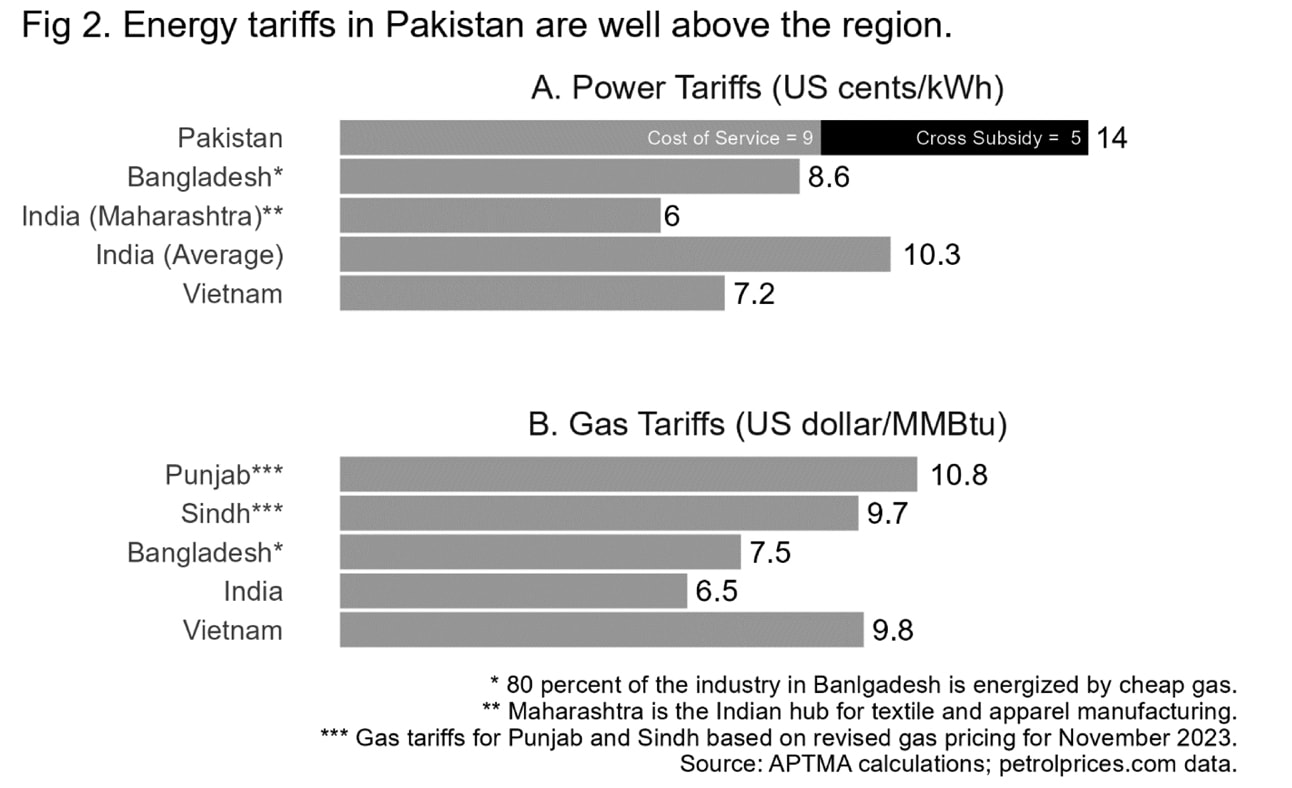
Power tariffs for exporters include a cross subsidy of around 5 cents/kWh to nonproductive sectors, making them almost twice the regional average. Similarly, gas prices following the recent reform have been increased to well above what prevails in the region, especially amongst competing economies (Figure 2).


Under the new pricing structure, the cost of captive power generation for export sectors has increased to as much as 15 cents/kWh for SNGPL and around 12 cents/kWh for SSGC consumers, which is around the same as getting electricity from the grid so that there is no real benefit in captive power generation. A statement from the IMF (International Monetary Fund) confirms that this was indeed the government’s purpose behind setting gas prices at these levels.

Ironically, captive power generation is—in the first place—incentivized by prohibitively high power tariffs that force productive sectors to pay for the government’s own social obligations and inefficiencies through cross subsidies, transmission and distribution losses, and stranded costs, etc.

The obvious balancing act was to remove the cross subsidy from power tariffs and equalize end-use prices for captive and grid electricity to shift industry away from captive generation. Instead, the government has included these unwarranted costs in gas prices to further undermine export competitiveness.

In the case of electricity—as acknowledged by the Power Division and power regulator NEPRA—a component of the cost of generation for power used by residential and agricultural consumers is extracted from industrial and commercial consumers, and this cross subsidy is clearly seen if one compares the power tariffs across different categories to the cost of generation and service (Figure 3).


But in the case of gas, it is a fuel delivered to consumers to convert and use as they prefer—i.e., as electricity in the case of industrial captive, and heat in the case of industrial process or household cooking and heating. Of the country’s total consumption, around 75 percent is indigenous gas, the cost of which, as per Ogra, is Rs 1,350/MMBtu, and 25 percent is imported LNG at approximately $13.50/MMBtu based on October 2023 rates. Accordingly, the weighted average cost of gas is around Rs 1,990/MMBtu.

Revised gas prices for export captive are Rs 3,145/MMBtu from March to November and Rs 3,830/MMBtu from December to March for SNGPL, and Rs 2,800/MMBtu throughout the year for SSGC consumers. Because prices for exporters are well above the cost, there is no subsidy to the export sector and, if anything, the export sector is again being made to subsidize the government’s debt and consumption in other sectors of the economy.

However, since we do not have enough indigenous gas to meet the entire country’s demand, the question of gas pricing is really one of resource allocation. By the law of price and demand, sectors that are subject to lower prices will consume more gas. So, do we want to allocate more gas towards productive uses, that will add value, earn foreign exchange, mobilize government revenue, stabilize the external sector, provide jobs, and create opportunities for productive investment that create future returns and benefit generations to come, or do we want to continue to burn away our precious resources in nonproductive activities?

The answer, based on prevailing policies, seems to be the latter. The energy sector provides vulnerable segments with cheap and underpriced electricity and gas but does so by systematically dismantling productive sectors that provide jobs to the same people, enabling them to purchase the same energy, efficient appliances and much more without any subsidies.

But this logic seems to completely escape the naysayers. Our policies continue to suppress exports while protecting unproductive non-traded sectors to substitute imports—a strategy that has terribly failed in Pakistan and many countries around the world.

The country’s international image and economic potential have deteriorated so severely that even strong and long-standing bilateral partners like Saudi Arabia and China have become wary of putting their money in Pakistan. For all our efforts to bring in foreign investment, nothing is materializing and how can it in a country where even domestic investors are increasingly parking their money in the safest and least productive of assets?

Pakistan’s gross external financing requirements, including current account deficits and amortization of debt, are, on average, projected at around $27 billion annually over the next 5 years. Prospects for receiving foreign investment remain bleak, and foreign investment in non-export sectors that do not generate returns in foreign currency is a liability in any case.

This is where we stand now: The foreign exchange shortage continues to persist, and exports for FY24 are likely to remain well below the FY22 peak of $32 billion. Following a brief appreciation, the exchange rate is depreciating again, which, coupled with the increase in gas prices, could very well reverse the downward trajectory of inflation, and result in a prolonged period of high interest rates. All of this will continue to cripple real economic growth and diminish the chances of recovery.

To come out of this vicious cycle of crisis after crisis and achieve sustained economic growth, a fundamental strategy of fostering competition and increasing exports must be adopted at all policy levels, across all sectors of the economy. Exports are competitive only if export sector input costs are at par with competing economies. Any form of taxation, either direct like sales tax or indirect like cross-subsidies, cannot be exported. The choice is simple: Export or perish.


655287f16d410.jpg

November 14, 2023

By Shahid Sattar | Syed Absar Ali

Distortions caused by a distraught policy landscape — from high energy costs to an industry-wide liquidity crisis — have made it next to impossible for Pakistani exporters to compete in international markets.

To put things into perspective, Bangladesh exported more in ready-made garments ($15.7 billion) in the past four months than Pakistan’s total exports since January of this year ($13.3 billion).

While Pakistan has no shortage of rhetoric around increasing exports, policy makers remain dangerously oblivious to the fact that export sectors require a distortion-free environment to enable them to compete in international markets.

Currently, they are provided with anything but a level playing field.

Energy, on average, accounts for between 12 and 18 percent of input costs across the textile and apparel value chain. A cross subsidy of Rs 10.84-16/kWh embedded in power tariffs for industrial makes them almost twice the average for major textile exporting countries in the region (Figure 1A). Similarly, manufacturers across the country are faced with constant gas shortages with no end in sight while the impact of the gas pricing reforms, that place RLNG/gas rates well above a regionally competitive level (Figure 1B), is yet to be seen and evaluated.

The industry is also faced with a severe liquidity crisis. Due to rampant exchange rate depreciation and inflation experienced over the past year, the same dollar-denominated export order requires around 40% more rupees to process.

However, there is a severe shortage of working capital, and what little is available comes at exorbitant interest rates. Non-bank credit across the supply chain is a lifeline for Pakistani businesses, but with interest rates at over 22 percent investors are finding it more profitable to simply park money in banks. And over 70 percent of banking credit is being used to finance the government’s fiscal deficits, crowding out borrowing by the private sector.

The liquidity crisis is further propagated by around $1.3 billion (Rs. 370 billion) being stuck in the tax refund regime at any given time. FBR persistently delays issuance of sales tax refunds despite a 72-hour commitment under law and refuses to issue other refunds, including income tax refunds, non-FASTER refunds, custom duty drawbacks, etc., that have been pending for years. There is no logical reason for this except that the government needs this money to manage its own troubled cash flows, but at what cost?

Then there is the issue of close to no fixed capital investment in up-gradation and expansion of production capacity—one of the reasons for a long-term decline in manufacturing productivity. According to industry estimates, 50 percent of spindles in the textile sector will be scrapped without replacement over the coming year.

This means that Pakistan will not have enough upstream capacity to produce high-quality yarns that can be used in modern air-jet looms in downstream processes. The sizable investment that was made in up-gradation and expansion under TERF and other export financing schemes was either left incomplete due to restrictions on L/Cs on import of machinery or is sitting idle due to high energy and other operating costs.

If fixed capital investments remain abysmal, we will see an increase in imported intermediate products and a decline in domestic value added in exports over the coming months and years, further adding to the economy’s balance of trade deficit and external sector vulnerabilities.

Another issue is that of polyester staple fiber (PSF) prices. Domestic PSF suppliers—the basic raw material for man-made filaments and synthetic fibers—are exhibiting a ‘monopolistic’ behavior, keeping PSF prices artificially high.

This is made possible by heavy protection in the form of prohibitive import and anti-dumping duties on imports of cheaper and higher quality PSF.

This has created a “cotton-bias” in the industry, rendering it vulnerable to exogenous cotton supply and price shocks, and is a major challenge to export diversification within the textile sector export basket.

Add to this the plethora of bureaucratic red tape and regulatory sludge that exporters must regularly put up, Pakistan’s textile sector prices and turnaround times are simply too high to be able to compete with firms from regional textile and apparel hubs.

However, it is still not too late: given how the international policy landscape is shifting, the textile sector is still well-positioned to take advantage of these shifts, given a conducive policy environment at home, but further inaction could very well result in continued deterioration. Two important examples are discussed below.

First, the Carbon Border Adjustment Mechanism (CBAM) in Europe is expected to become fully functional at the end of this decade. Accordingly, by 2030, imports to the EU will be taxed for the energy emissions generated in their production outside the EU, effectively imposing an import tariff on any exports to the EU depending on their energy emissions.

To overcome CBAM-related taxes requires net-zero energy emissions across the export sector value chain. Bangladesh has already started to incentivize this: a recent policy requires new buildings with a rooftop area of over 92.2 square meters to have net-metered solar power to be eligible for a grid connection.

But in Pakistan, industrial consumers are subject to a cap of 1MW on solar net-metering. Furthermore, the textile sector has pledged to generate its own electricity using clean geothermal energy, but this requires B2B contracts with a wheeling charge of no more than 1 cents/kWh, all inclusive. The government refuses to increase the cap from 1MW up to 5MW or allow B2B contracts, only to protect its own distorted revenue streams.

Second is the Western movement to decouple from China. According to the USFIA’s annual textiles and apparel industry benchmarking exercise, 80 percent of the largest apparel and clothing firms in the United States are planning to reduce sourcing from China over the next two years, and shift from a “China plus Vietnam plus Rest of the World” sourcing model to an “Asia plus Rest of the World” model.

Once again, Bangladesh and Vietnam have already taken advantage of this, and their shares in international textile and apparel markets have gradually increased since around 2014, while those of China have declined (Figure 2).

Both countries are also offering very attractive incentives to further expand their textile and apparel manufacturing capacities. In Bangladesh new ready-made garment factories pay income tax at preferential rates of 10-12%, with many firms being eligible for further exemptions of up to10 years.

In Vietnam, new projects are offered preferential income tax rates of 10 percent for 15 years, including a 2-year tax holiday and a 50 percent reduction for the subsequent 9 years. In both countries, these are in addition to other incentives such as duty-free import of raw materials and reduced tax rates on export earnings.

India, to counter the growing importance of Bangladesh and Vietnam, is setting up seven mega textile and apparel manufacturing parks with full vertical integration. These include ‘plug and play’ facilities, all sorts of ancillary infrastructure, common processing houses, design centers, testing facilities, workers’ hostels and housing, and training and skill development facilities. Additionally, $36 million has been allocated to each textile park to provide a rebate of up to 3 percent of annual turnovers to newly established factories.

This begs a very simple question: Why would any investor anywhere in the world choose to invest in Pakistan when this is what they are being offered right next door, in a much more stable and export-oriented economic environment? The answer is they would not, which is why our entire economy is functioning on a hand-to-mouth, loan-to-loan basis with abysmal investment — foreign direct or domestic — in any sort of productive activities.

The way forward is simple:

The government must ensure a distortion-free supply of inputs to export sectors, whether energy or raw materials. It must remove the cross-subsidy embedded in power tariffs for exporters, allow B2B power contracts with a wheeling change of 1 cents/kWh all inclusive, raise the cap on solar net metering for all industrial consumers from 1MW up to 5MW to support the move towards net-zero, and ensure adequate supply of gas/RLNG at regionally competitive prices.

On PSF, import duties must be rationalized and irrational anti-dumping duties removed entirely. All imported inputs for the textile sector must be duty-free at the point of entry because duty rebates are economically inefficient and cause a loss of purchasing power to the exporters when they are inevitably and indefinitely delayed.

FBR must get its house in order, issue all pending tax refunds at once, and honor the commitment of issuing all FASTER refunds within the stipulated timeframe of 72 hours. Customs procedures for exports and export-sector imports must also be simplified and processing times reduced to enable faster turnaround times for export orders.

“Furthermore, there is an overall need to cut down on regulatory sludge, reduce the government’s economic footprint, and rationalize fiscal expenditures and revenues within a growth-oriented framework. This will reduce government borrowing, bring down inflation, allow for a reduction in the policy rate, and free up credit for private sector investment.”

To take full advantage of emerging opportunities, incentives offered by competing economies must also be matched or exceeded to stimulate investment in up-gradation and expansion of manufacturing and export capacity, both for domestic and foreign investors alike.

These may be bitter pills for policy makers to swallow but the only alternative is another crisis on the horizon—one we really cannot afford.


GSP-Labour-Standards.jpg

November 6, 2023

SUMMARY OF RECOMMENDATIONS

The report ‘GSP+ and Compliance with Fundamental Labour Standards’ was prepared and recently published by the Ministry of Overseas Pakistanis and Human Resource Development with technical support from ILO. A summary of key and specific recommendations (mainly focused on legislative and administrative reforms) is presented here for the government, decision-makers and industry stakeholders to get a deep insight of Pakistan’s current compliance with the fundamental labour rights and essential reforms at legislative, administrative and industrial levels. These recommendations are based on the observations made by the ILO Committee of Experts on Application of Conventions and Recommendations (CEACR).

Qualification for the EU GSP+

A country with the following criteria is eligible for GSP+

  1. The country must be considered ‘vulnerable’
    • Not classified by the World Bank as high or upper-middle income country during three consecutive years preceding the update of the list of beneficiary countries
    • Its imports to the EU are concentrated in few products (seven largest sections of its GSP-covered imports into the EU represent more than 75% in value of its total GSP-covered imports
    • Its imports to the EU are low (its GSP-covered imports into the EU represent less than 6.5% in value of the EU’s total GSP-covered imports from all GSP beneficiaries)
  2. The country must ratify all 27 core international conventions related to human and labour rights and environment and good governance
  3. Monitoring bodies under these core conventions must not identify a serious failure to the effective implementation of these 27 conventions
  4. The country must not have formulated any reservations prohibited by the relevant conventions or that is identified to be incompatible with the purpose of the convention
  5. The country must comply with the following “binding undertakings”:
    • Maintain ratification of 27 conventions and ensure their effective implementation
    • Accept without reservation reporting requirements and monitoring and review by the conventions
    • Accept to participate in and cooperate with the EU monitoring procedure

Pakistan’s Labour Rights Status

The most recent GSP+ progress assessment report for Pakistan was published in 2020.

The report identifies that provinces have made some progress in adopting legislation and developing guidelines to support implementation of ILO fundamental conventions. Development of the National Labour Protection Framework by the MOPHRD as well as improvements in child labour are also praised. However, the remaining concerns of the EU are related to areas of rights of collective bargaining and trade unions, wage discrimination, lack of labour inspection systems, occupational health and safety and child, forced and bonded labour in agriculture and mining.

The report highlights that Pakistan requires a comprehensive child labour law that not only covers child domestic workers but also prohibits children under 18 from engaging in hazardous work. Regarding Labour Inspection Convention, it is noted that number of provincial inspectors must be enhanced to conduct regular inspections and carry out legal actions on law violations. Concerning occupational health and safety, some improvement in the legislation is observed but the adoption and implementation is lacking. Lastly, it is recommended that labour conventions must be extended to EPZs and SEZs.

Pakistan’s Compliance with Fundamental Labour Rights – Recommendations

  1. Freedom of Association

LEGISLATIVE REFORMS

  • Federal and provincial legislation must be amended to
    • Allow workers engaged in more than one job to join the corresponding union of their choice, that is, more than one union
    • Ensure that minority unions are able to protect their workers’ interests and have access to check-off facilities
    • Ensure that grounds for disqualification for holding a trade union office are more restrictive and have real connection with qualities of integrity required for the exercise of trade union office
  • Amend definition of workers to include persons involved in intellectual/non-manual, clerical and other work
  • Amend Industrial Relations Act (IRA) and provincial IRAs with regards to
    • Formation of trade unions
    • Minimum membership criteria of 20 per cent for every third and subsequent union
    • (permanent) disqualification from a trade union office because of conviction under the Pakistan Penal Code 1860
  • Allow sectoral or general trade unions, especially in the informal sector

ADMINISTRATIVE REFORMS

  • Make the Registrar (Trade Unions) Office independent from the National Industrial Relations Commission (NIRC)
  • Promote collective bargaining by making the union registration and referendum holding processes easier
  • Require the submission of annual returns by trade unions. Non-compliance should lead to cancellation of registration. Provincial as well as federal Registrars of Trade Unions should devise these annual return forms together in order to collect reliable data
  • The MOPHRD should work with the Pakistan Bureau of Statistics to include trade union and collective bargaining-related questions in its upcoming labour force survey
  • Arrange industrial relations training for the Registrar of Trade Unions, conciliators and labour inspectors
  • Arrange orientation sessions for workers’ and employers’ organizations on industrial relations legislation and rights and responsibilities of both parties under the law
  • Develop a manual/toolkit on registration of trade unions
  • Ensure the establishment of a Works Council and/or Joint Management Board
  1. Equality of Treatment and Opportunity
  2. Protection of Domestic Workers
  3. Protection Against Harassment
  4. Protection of Minorities

PROPOSED REFORMS

  • Amend the definition of wages in Payment of Wages legislation in all provinces
  • Amend provincial legislation on payment of wages to give full expression to the principle of equal remuneration for men and women for work of equal value
  • Amend minimum wage legislation and payment of wages legislation
  • Develop and implement objective job appraisal methods
  • Provide information on any legislative developments regarding Employment and Service Conditions Act (ESCA), or any other legislation that would carry similar mandate
  • Training and awareness raising at the level of minimum wage boards to ensure that the minimum wage setting process is free from gender bias
  • Publish clear data on cases of unequal remuneration or wage discrimination in the Annual Labour Inspection Report
  • Carry out awareness raising activities on promotion of the right to equal remuneration for work of equal value, together with the employers and workers’ organizations
  • Compile data on gender pay gaps (at sectoral and occupational level)
  • Address occupational segregation of females in low paying jobs and occupations through time-bound affirmative action
  • Amend the legislation provisions to ensure these explicitly define and prohibit direct and indirect discrimination, apply to all aspects of employment and occupation, including at the recruitment stage, and cover all workers
  • Amend anti-harassment legislation to protect men against sexual harassment in employment and occupation on an equal footing with women
  • Carry out awareness raising for employers and judges on anti-sexual harassment laws
  • Publish information on implementation of anti-harassment laws including the adoption of internal codes of conduct and the constitution of complaints committees to adjudicate complaints against harassment
  • Raise awareness of the Transgender Persons (Protection of Rights) Act 2018 among workers, employers, and their respective organizations as well as enforcement authorities
  • Enforce the prohibition of and to eliminate discrimination based on caste and promote their inclusion in the labour market
  • Amend discriminatory legal provisions and administrative measures and to actively promote respect and tolerance for religious minorities
  • Provide information on employment of religious minorities, especially the 5% quota in the public sector
  • Take measures to promote tolerance and equality of opportunity and treatment in employment and occupation for religious minorities
  • Make payment of maternity benefit mandatory through social security system
  • Invest in safe and affordable transport for women, with a focus on female-only transport
  • Increase access to affordable internet and support women by providing training on cyber safety and skills needed for digitally enabled jobs
  • Wage subsidies to support wage employment opportunities for women with educational attainment
  • Invest in childcare support facilities and enforce existing laws related to maternity leave and childcare

OTHER LEGISLATIVE REFORMS

  • Enact a standalone anti-discrimination legislation that explicitly prohibits the following: “any distinction, exclusion or preference made on the basis of race, religion, caste, sex, color, creed, marital status, disability, trade union membership, residence or place of birth, which has the effect of nullifying or impairing equality of opportunity or treatment in employment or occupation.”
  • The law must also require non-discrimination on the ground of contract status as well as working time (full time versus part time), and should require registration of all workers with the social security institutions
  • At a minimum, legislation must carry a clear definition of discrimination and prohibit it on the above grounds
  • Amend legislation, especially the Factories Act and shops and establishments legislation, to remove the restrictive provisions on female participation in workforce
  • Gradually formalize the informal sector through the formulation of policies and legislation for domestic, home-based, construction, agriculture, and digital labour platform workers, among others

OTHER ADMINISTRATIVE REFORMS

  • The Punjab Women Empowerment Packages (2012, 2014, and 2016) need to be emulated by the federal and provincial governments.
  • Encourage women’s labour force participation by extending incentives (tax rebates) to businesses
  • Train the Labour Inspectorate and social partners on different forms of discrimination and legal provisions and international standards concerning discrimination
  • Operationalize gender-sensitive labour inspections, data handling and reporting
  • Recruit female labour inspectors
  • Register informal sector workers with the Employees’ Old-Age Benefits Institution (EOBI) and Provincial Social Security institutions (PESSIs) by reducing the contribution rates. The Government must ensure systematic registration of unregistered workers and units through improvement in the labour inspection system
  • Share the cost of maternity leave pay (12 weeks of pay) between employers and the federal and provincial governments in order to raise female labour force participation
  • Initiate baseline studies on compiling and analyzing statistical information on remuneration/wage gaps between men and women across economic sectors and across value chains
  • Develop a knowledge base and scholarship on discrimination in employment and occupation by collaborating with universities and research centers
  1. Elimination of Forced Labour

PROPOSED REFORMS

  • Publish data on investigations, violations, prosecutions and convictions regarding bonded labour and the number of freed bonded labourers in the annual labour inspection report
  • Publish information on combatting bonded labour and supporting freed bonded labourers, including actions taken under the National Strategic Framework
  • Establish and strengthen the Domestic Violence Crisis Services (DVCS)
  • Collaborate with the Pakistan Bureau of Statistics (and provincial bureaus) and conduct sectoral surveys on bonded labour
  • Publish annual statistics number of investigations, prosecutions, convictions and the specific penalties imposed under PTPA, PSMA and relevant sections of PPC
  • Amend the provisions in selected legislation, either by repealing them, by limiting their scope to acts of violence or incitement to violence, or by replacing sanctions involving compulsory labour with other kinds of sanctions
  • Federal and Provincial Governments to amend respective Essential Services (Maintenance) Acts

OTHER LEGISLATIVE REFORMS

  • Enact a standalone legislation on forced and bonded labour in line with the principles of Conventions Nos 29 and 105
  • Rationalize and amend the Bonded Labour System Abolition Acts to incorporate forced labour and raise penalties
  • Harmonize bonded labour legislation with other legislations, for example, the Payment of Wages Act and the Standing Orders Ordinance
  • Develop subsidiary Rules for the amended or newly enacted laws on forced labour

OTHER ADMINISTRATIVE REFORMS

  • Restructure the District Vigilance Committees to make them more effective
  • Train the Labour Inspectorates and District Vigilance Committees to effectively monitor and address issues of forced and bonded labour
  • Conduct bonded labour surveys to gauge incidence of bonded labour in various economic sectors
  • More strictly enforce working time and payment of wages laws by strengthening the labour inspection system
  • Include questions regarding forced labour in the upcoming Labour Force Survey to gauge actual incidence of forced labour in the formal and informal sectors
  • Conduct capacity-building of Provincial Labour Departments in identifying instances of forced labour in the formal and informal sectors (and strive towards gradual formalization of the informal sector)
  • Secure convictions under the Bonded Labour System (Abolition) Act 1992
  • Bring workers in the formal sector into the social safety net
  • All shops and establishments must be registered and workers’ employment records must be maintained by employers and a designated state department
  • Access to social security institutions (like the ESSI, EOBI and WWF) should not be based on the employment contract status of a worker


  1. Abolition of Child Labour

PROPOSED REFORMS

  • Amend the provincial legislation and raise the minimum age for admission to work to 16 years
  • Amend the Employment of Children Act 1991 and add necessary provisions in draft laws to raise the minimum age for hazardous work to 18 years
  • Amend employment of children legislation and to incorporate the provisions on minimum age for light work for limited hours and the minimum age for engaging a child in light work
  • Hold consultations at federal and provincial level to avail the possibility of excluding the work in family run establishments from the scope of Convention
  • Strengthen the capacity of the labour inspectorate, and to continue providing information on the number and nature of violations relating to the employment of children detected by the labour inspectorate
  • Share results of the provincial child labour surveys as well as the updated information on the Child Labour Surveys which are in progress
  • Provide information on implementation of relevant sections of employment of children legislation in Punjab and Sindh
  • Provide update on the implementation of laws in abolishing bonded labour
  • Provide information on the number of child bonded labourers identified by the DVCs and other law enforcement officials, the number of violations reported, investigations conducted, prosecutions, convictions and penal sanctions imposed
  • Provide and publish updated information on number of cases that relate to the trafficking of children under 18 years of age as well as the number of investigations and prosecutions carried out and penalties imposed
  • Provide and publish updated information on measures taken to identify child victims of trafficking as well as on the measures taken to ensure their rehabilitation and social integration
  • Ensure effective implementation of the prohibition on employment of children legislation and provisions of the Pakistan Penal Code
  • Adopt, amend and revise hazardous works list in consultation with employer and worker organizations
  • Protect children under 18 years of age engaged in the brick kiln industry from hazardous work
  • Provide information on the implementation of the 2016 National Strategic Framework to Eliminate Child and Bonded Labour and its recommendations to eliminate child bonded labour and its impact in eliminating child bonded labour during the last 6 years
  • Provide information on the implementation of any other projects at the provincial level to combat child bonded labour, and to provide information on the results achieved, including the number of children removed from bonded labour and provided assistance, disaggregated by age and gender
  • Provide information on measures taken to provide free basic education to all children
  • Take effective and time-bound measures to protect and withdraw street children from engaging in the worst forms of child labour and provide for their rehabilitation and social integration
  • Publish information on the number of street children benefiting from shelter and other rehabilitative services
  • Enact legislation on domestic work in provinces of Baluchistan, Khyber Pakhtunkhwa, and Sindh
  • Include child domestic labour in the list of hazardous occupations under the employment of children legislation

OTHER LEGISLATIVE REFORMS

  • The current Employment of Children Act 1991 needs to be repealed and a new Prohibition on Employment of Children Act must be enacted
  • The new laws enacted in all provinces need to be amended as follows: a. The minimum age for admission to full-time work must be set at 16 years b. The minimum age for light work should be set at 12–14 years and limits on hours for such light work must be set. Similarly, appropriate light work and hours of work for adolescents aged 14–16 must also be specified
  • Formulate a light work list (that is, work allowed for children as young as 12 years)
  • Frame subsidiary rules under the various prohibition of child labour legislation in all provinces

OTHER ADMINISTRATIVE REFORMS

  • Complete child labour surveys and make available accurate and reliable statistics
  • Strengthen the oversight mechanisms at the provincial level (through provincial committees on child labour)
  • Engage in awareness-raising among employers and workers regarding the menace of child labour
  • Extend coverage of legislation to sectors with high incidence of child labour (domestic work, workshops, and so on)
  • Develop model child labour-free districts


  1. Occupational Safety and Health

PROPOSED REFORMS

  • Adopt Occupational Safety and Health law in ICT, GB and AJK
  • Provide information on private auditing firms in the country performing OSH audits
  • Provide information on non-public actors involved in labour inspection, the proportion of labour inspection performed in this manner, and how such non-public actors are being supervised by the Government
  • Raise the level of fines, alone or in combination with other penalties, to a level which is sufficiently dissuasive as a sanction for violations
  • Publish the data on labour inspectors, workplaces liable to inspection and number of inspections conducted, in annual labour inspection reports
  • Strengthen the labour inspection authorities by filing the vacant positions, establishing more offices, providing transport, and imparting training to the labour inspectors
  • The provincial governments must frame necessary rules and start collecting data on fatal, non-fatal accidents and occupational diseases on a regular basis
  • Improve the detection and identification of cases of occupational diseases
  • Governments of Punjab and KPK also need to update the list of occupational diseases
  • Amend legislation allowing inspectors to enter, first, freely and without any previous notice, and second, at any hour of the day and night
  • Revise and update the penalties for violation of labour legislation. The fines should be linked with the applicable minimum wage, e.g., Should be two times or four times the minimum wage and so on. Moreover, the minimum penalty for a violation must be equivalent to at least one minimum wage
  • Publish the annual labour inspection report and make it accessible to the public through MOP&HRD’s website. Share the annual labour inspection reports with the ILO
  • The number and percentage of female labour inspectors need to be gradually raised to 20% of the total sanctioned strength of labour inspectors in the country
  • Frame subsidiary Rules for the already enacted OSH laws to facilitate enforcement of OSH provisions
  • Develop and operationalize OSH codes of conduct

OTHER ADMINISTRATIVE REFORMS

  • Update the inspection proforma
  • Redesign the inspection manuals at the provincial level
  • Digitize inspection reporting
  • Strengthen health and safety inspections in all sectors
  • Initiate system-based inspection to improve the OSH situation in the country
  • Provide capacity enhancement of inspection staff in key aspects


  1. Tripartite Consultation and Social Dialogue

ADMINISTRATIVE REFORMS

  • Determine the most representative organizations of workers and employers
  • Hold Provincial Tripartite Labour Conferences annually
  • Hold regular meetings of the federal and provincial tripartite consultative committees
  • Publish annual reports on the discussions and decisions made at the FTCC and PTCCs level
  • Sensitize employers and workers to the existing provisions in laws promoting bilateral and tripartite social dialogues
  • Expand the membership of the Federal Tripartite Consultative Committee to national level centers/institutes working on labour rights and similar issues 


653ed2ff23301.jpg

October 30, 2023

By Shahid Sattar | Noreen Akhtar

Net Zero is an international agreement for climate action that aims to achieve a balanced state of greenhouse gases in the atmosphere through emissions reduction and emissions removal from the atmosphere.

The Paris Agreement and IPCC (Intergovernmental Panel on Climate Change) underline the importance of net zero to meet the goal of 1.5°C by 2050 – the climate benchmark for the world’s average temperature that should not exceed that of pre-industrial times by more than 1.5°C.

The Paris Agreement requires states to “achieve a balance between anthropogenic emissions by sources and removals by sinks of greenhouse gases in the second half of this century”.

Significant reduction in GHG emissions is required to limit the ever-rising global warming, as the climate crisis cannot be tackled without transitioning to net zero. This transition requires clear and sustainable financing mechanisms as well as robust and long-term net zero targets in all major GHG emitting sectors, including energy, transport, and agriculture.

Requiring businesses to go green and carbon neutral by developing Science Based Targets and decarbonising their value chains is critical to not only avoid irreversible ecological catastrophes caused by climate crisis but also fulfil major compliance demands from countries importing from Pakistan.


Climate change affects countries in an inequitable manner thus posing existential threats to the already dwindling economies and vulnerable communities. Therefore, net zero has the potential to be a climate justice tool if its targets redress the injustices fairly (Khosla et al. 2023). Climate-vulnerable but low-emissions countries such as Pakistan are required to strengthen their climate actions and cut their emissions.

However, this unfair burden of emissions removal requires ambitious inclusive governance processes to support a transition towards SDGs.

Pakistan is experiencing massive losses from climate change. Net zero targets, therefore, are crucial for Pakistan to not only enhance resilience to climate impacts but also mobilize the global community to strengthen the component of fairness for mitigating climate change.

Pakistan’s updated climate pledge has set a “cumulative conditional target” of limiting emissions to 50% of what it expects its business-as-usual levels to be in 2030. Moreover, due to mounting global compliance requirements and to retain its status in the global market, Pakistan’s largest export sector – the textile industry – has taken promising initiatives to achieve net zero emissions targets in collaboration with other institutions.

Net zero coalition

Net Zero Coalition, also known as Net Zero Pakistan was convened by Pakistan Environment Trust in 2021. It is a collaboration among leading textile firms, non-governmental organizations, sector experts, and public institutions to enhance corporate climate action to achieve net zero by 2050. Through this coalition, the private sector aims to accelerate its sustainability efforts, decarbonize value chains and advocate for climate action and justice. Net Zero Pakistan is one of the first initiatives from the global south to be recognized by the UN’s Race to Zero campaign.

Net zero and Pakistan’s energy sector Overview

Globally, three-quarters of the GHG emissions come from the energy sector. The International Energy Agency (IEA) states that under the Net Zero Emissions (NZE) scenario, CO2 emissions fall by 40% by 2030 and to net zero by 2050, methane emissions from fossil fuels reduced by 75% by 2030 and solar and wind become leading energy sources of electricity globally. However, this is accomplished only if key pillars of decarbonization are adopted through a range of policy approaches and technologies. These pillars are energy efficiency, behavioral changes, electrification, renewables, hydrogen, and hydrogen-based fuels, bioenergy, and CCUS (Carbon Capture, Usage, and Storage).


The energy sector is the largest GHG emitter in Pakistan. A heavy reliance on fossil fuels for primary energy supply (67.9% in 2022) has exposed the country to energy insecurity, and GHG emissions. Despite Pakistan’s substantial solar and wind potential, these resources have been underutilized, often due to vested interests and unfounded concerns about “surplus capacity”. To achieve the goals set in the 2019 Alternative and Renewable Energy (ARE) Policy and the 2021 National Electricity Policy (NEP), competitive bidding for new climate-friendly power generation projects and discontinuing the old practice of direct contracting and cost-plus tariffs are imperative.

Pakistan’s energy intensity of GDP is comparatively high in the region, signaling substantial room for demand-side efficiency improvements in alignment with the global decarbonization targets. With an energy intensity of 4.6 megajoules per dollar in 2018, compared to 4.4 MJ/$ in India, 2.6 MJ/$ in Turkey, 2.5 MJ/$ in Bangladesh, and 1.8 MJ/$ in Sri Lanka, there is a significant scope for enhancement. Moreover, Pakistan’s energy efficiency improvement rate of 1.2% over 2000–2018 falls short of the SDG7 (Affordable and Clean Energy) global target of 2.6%, emphasizing the need for accelerated progress in this regard.

While Pakistan is already grappling with challenges such as policy inconsistency, resource allocation issues, and a stressed economy, the country must immediately harmonize its economic needs with the overarching sustainable and climate energy objectives. The following approach is recommended to transform the energy sector sustainably to support climate action.

Decarbonise the industry first

In the quest for net zero, electricity is the new oil. Interventions such as advancement in the electrification of public transportation, implementing solar PV for distributed generation, tube well operations, and utilization of space heating and cooling using heat pumps (Heat & Cool ACs) in winter and solar geysers are crucial to establishing a sustainable and environment-friendly electricity system in Pakistan.

Also, exploring the potential for geothermal as a carbon-neutral source of energy will be a win-win situation for all. However, all of this entails investment and government support in the form of reasonable wheeling charges and an enabling environment.

Export Industries, on the other hand, can achieve net zero without any financial support except by increasing net metering limits to 5MW and expediting wheeling at 1 cent/kWh. It will not only help Pakistan maintain its GSP+ status but also give benefits of net zero products in the EU and GCC augmenting exports with cheaper green electricity and zero carbon products.

Decarbonise the power sector

Ensuring a stable, reliable, and continuous energy supply within an isolated grid, while simultaneously pivoting towards net-zero, necessitates meticulous planning and implementation of contingencies. There’s a requisite for robust infrastructural investments, innovative energy storage solutions, and an adept integration of renewable energy sources to minimize the vulnerabilities associated with isolated grids. Moreover, resilient policies and strategies should be sculpted to ensure that the transition toward decarbonization does not jeopardize energy security, particularly in scenarios where renewable sources may be intermittent or variable.

Conclusion

Pakistani exporters must realize that net zero is no more a voluntary environmental and sustainability initiative; it is a requirement for compliance with the upcoming environmental regulations such as the EU’s Carbon Border Adjustment Mechanism (CBAM).

“As the EU is placing stringent obligations that require importers to import climate-friendly products with less emissions, achieving net zero is a matter of survival for the industry and exports in the global market. An energy system established on net zero targets is crucial for Pakistan to not only counter climate catastrophe and ensure access to climate justice but to also achieve access to sustainable, equitable, and economically feasible energy sources.”


653991605623e.jpg

October 26, 2023

By Shahid Sattar | Engr Tahir Basharat Cheema

No other commodity in Pakistan creates more economic distortions than electricity. Normal goods, public goods, inferior goods, and Giffen goods are the few kinds of goods that exist in economics.

Such is the scale of the crisis in Pakistan’s energy market—if it can be called a market at all—electricity cannot be classified under any of these.

We are in a place where the discourses driving decisions on issues with implications for the entire economy have become so severely misinformed that the record must be set straight.

It has been recently claimed that “Pakistan’s consumer tariff is based on the principle of equity: it transfers resources from the rich to the poor; from richer regions to poorer regions; and from federal pool to poor consumers in poorer regions”.

Apart from the oblivious mischaracterization of facts, such as that there is no nomenclature providing for “rich” or “poor” consumer tariffs and that there is no “federal pool”—only a growing pile of circular debt backed by large and persistent fiscal deficits—this statement runs contrary to all economic norms and public policy rationale.

Pakistan’s power sector is characterized by a state that is partially unable, partially unwilling to mobilize revenue generation capacity and is therefore bent on exploiting its unholy monopoly in the power sector for a pretend redistribution of income, no matter how damaging the consequences.

Around 68 percent of domestic consumers in Pakistan fall under the protected category and another 25 percent are lifeline consumers. Together they account for 73 percent of domestic power consumption.

The remaining 7 percent of domestic consumers—often referred to as high-end domestic—pay full tariffs and account for 27% of around 56,000 GWH of total domestic consumption.

The size of the subsidy given to protected and lifeline consumers is between Rs. 900 billion and Rs. 1 trillion rupees, both according to the Power Division and by our own estimates. All else aside, it is not mathematically possible for high-end domestic consumers — i.e., “rich” consumers—to pay for a subsidy of Rs 900 billion.

This begs the question, who is really paying for this subsidy? The answer is: it depends. Directly, it is a combination of high-end domestic, commercial, and industrial consumers with a cross-subsidy embedded in their power tariffs.


But once we consider the economic linkages that exist between all agents of the economy, everyone is paying for it—including and especially the protected and lifeline consumers whom it is meant to benefit.

Because electricity is an input across all sectors of the economy, taxes embedded in electricity prices are always passed on to the final consumers.

First, this adds to the lack of productivity and competitiveness in domestic activities, thus requiring even higher levels of protection from imports, fuelling distortions in domestic markets.

Second, and more importantly, it results in a loss of welfare for consumers across the board, but substantially more so for the poor than for the rich because the rich—by virtue of their wealth—are always willing to pay more for any given commodity than the poor.

But what is even more dangerous is when such taxes are imposed on export sectors. In the case of exports, the final consumers are international buyers with relatively elastic demand.

When the price of electricity for export sectors rises significantly above that faced by competing firms in other countries, demand disappears, and the industry inevitably collapses. This is what is happening in Pakistan.

Power tariffs for industrial consumers contain a cross-subsidy ranging from Rs 10.85/kWh, according to government sources, to Rs 16/kWh, according to our own estimates that are largely consistent with those from research institutions like the Pakistan Institute for Development Economics. This makes the power tariffs faced by Pakistani exporters almost twice the regional average (Figure 1, below).

  • Tariffs in Pakistan can fluctuate between 14 to 16 cents/kWh based on prevailing exchange rates. 14 cents/kWh is based on $1 = Rs. 280.

** 80% of industry in Bangladesh is energized through competitively priced gas.

*** The bulk share of the Indian textile industry is located in the state of Maharashtra.

With energy costs accounting for around 12% of total input costs during the RCET regime, our estimates suggest that a rise in power tariffs from 9 cents/kWh to the current 14 cents/kWh reduces firms’ net profitability from an average of 8 percent to only 1 percent and crowds out the export sector. To connect this with reality, one only needs to look at the abysmal state of FY23 profits reported by publicly listed textile firms, and the continued decline in textile exports (down 10% in FY24Q1, year-on-year).

Not only have exorbitant power tariffs had a direct impact on export firms and the millions of jobs they generate, but the effects have spilled over across the entire value chain.

Over 60% of production across the country is halted and Faisalabad is completely shut; mill owners are scrapping their machinery at Rs 120/kg to pay outstanding electricity bills and leaving the sector, and cotton prices are plummeting because there is no downstream demand.

“There is broad consensus on a need for deep-rooted structural reforms to save our ailing economy from this destruction. However, what is poorly understood is that deep-rooted structural reforms are a precarious and continuous process, the utmost prerequisite for which is a relatively stable macroeconomy that is currently absent in Pakistan. Achieving this level of stability requires a sustained increase in exports to build up economic buffers necessary to shield the economy from exogenous and endogenous shocks during the reform process.”

The only realistic avenue to achieve this over the near and medium term is to reform how electricity is provisioned to export-oriented sectors.

First, export-oriented industries must be provided with a separate power tariff category, excluding economic inefficiencies like stranded costs and cross-subsidies.

This will provide competitive electricity tariffs that don’t inhibit the ability of exporters to compete in international markets. Second, the government must initiate a move towards a free-market and distortion-free power sector by allowing B2B contracts for power wheeling at a wheeling charge of 1 cent/kWh, all-inclusive.

And finally, the cap on solar net-metering for industrial consumers must be increased from 1MW up to 5MW to provide 5,000MW at the point of usage and move towards net-zero emissions in exports — required by 2030 to continue exporting to key Western markets.

Otherwise, the Power Division must explain the unjustified loss of livelihoods to the nation.


65359a02cfdd5.jpg

October 23, 2023

By Shahid Sattar Noreen Akhtar

The GSP+ scheme has been extended for Pakistan for four additional years. However, the threat is not over. It is essential to note that the extended GSP+ is more stringent and failure to the effective implementation of all the mandatory conventions can lead to the withdrawal of the status. Continuation of the GSP+ extension is subject to whether Pakistan will ratify additional conventions and advance its current efforts of compliance with the compulsions.

Background

The EU granted Pakistan the GSP+ in December 2013, which came into effect from January 2014 onwards. This preferential tariff-free status provided a competitive advantage to Pakistan in the global market as the largest GSP+ beneficiary.

Not only Pakistan’s total exports to the EU observed a remarkable gain (more than 60% – around $10 billion in 2021 compared to $6 billion in 2013), but GSP+ also enhanced Pakistan’s capabilities to grow in a sustainable manner, diversify its economy and create employment opportunities. It accelerated the country’s efforts in improving compliance with major human and labour rights and environment and good governance-related international conventions.

Pakistan’s textile industry is the largest beneficiary of the GSP+. More than 80% of total exports to the EU from Pakistan are textiles. In 2021, Pakistan exported more than $7.7 billion worth of textiles to the EU. The top textile export products include trousers, not knitted; bed linen, not knitted and not printed and jerseys, knitted.

There are two special arrangements and one general arrangement under the EU’s GSP scheme. General arrangement applies to lower or lower-middle-income countries that receive duty reductions for 66% of all EU tariff lines.

EBA (Everything but Arms) is a special arrangement that applies to LDCs (Least Developed Countries) that receive full duty-free access to all products except arms and ammunition. GSP+ is the second special arrangement that applies to developing countries that ratify 27 core international conventions on human and labour rights and environment and good governance. These countries receive zero-duty access to the same 66% of all tariff lines covered under the GSP general arrangement.

Areas of improvement

PRIME’s recent study estimates that if GSP+ is revoked, Pakistan will lose more than one-third of its exports to the EU (more than $3 billion in terms of trade loss in 2021). This will pose existential threats to Pakistan’s largest export industry – the textile sector. Other resulting threats such as loss of employment opportunities and decent livelihoods, gender discrimination, and non-compliance to human and labour rights will significantly hinder Pakistan’s advancement to accomplish sustainable development.

The EU’s previous reports on GSP+ monitoring as well as ILO’s recent publication on Pakistan’s compliance with labour standards indicate that significant progress in terms of human and labour rights is crucial for Pakistan to boost its economy sustainably.

Fundamental human and labour rights such as freedom of association and collective bargaining, elimination of forced and bonded labour, abolition of child labour, and elimination of discrimination in occupation must be protected. The global community has serious concerns pertaining to non-compliance to occupational health and safety as well as a lack of tripartite consultations and social dialogue.

The ILO has added two more conventions (the Occupational Safety and Health Convention, 1981 (No. 155) and the Promotional Framework for Occupational Safety and Health Convention, 2006 (No. 187)) to its list of conventions on fundamental workers’ rights. Both conventions have not been ratified by Pakistan. However, the analysis of the current compliance progress indicates that Pakistan may be required to ratify these treaties in addition to other conventions to be added under GSP+.

Pakistan must strive to avoid revocation of GSP+ status by ensuring compliance with the EU requirements and utilizing the status further. There is a greater scope in diversifying export products within the textiles and exploiting untapped trade potential with countries other than the conventional export destinations such as Germany, Spain, and the Netherlands. Further, GSP+ removes tariffs on more than 66% of all tariff lines. However, these tariff lines are not being fully exploited. These untapped tariff lines with no penetration and easy competition should be fully explored.

Moreover, Bangladesh’s graduation from LDC to the developing country in 2029 thus losing its EBA status under the GSP scheme offers a generous opportunity for Pakistan to expand its textile exports.

“Upon graduation, Bangladesh will experience major trade losses to the EU due to the removal of the duty-free market access. PRIME’s analysis of trade loss indicates that Bangladesh will suffer market loss in women’s and men’s trousers and jerseys which Pakistan also exports to the EU substantially. A massive potential lies for Pakistani exporters to divert these trade losses in their favour.”

Additionally, digital traceability is another crucial obligation to ensure transparency in the supply chain. The textile industry must digitize its supply chain to disclose the data to verify that the manufacturing conditions are healthy and the impacts on the environment are minimal. Significantly low female labour force participation (FLFP), mounting industrial emissions, and lack of textile waste management are other areas requiring enhanced and sustained efforts to meet compliance targets.

Conclusion

A robust consideration of recommendations from the EU, ILO, and WB on compliance with fundamental requirements on human and labour rights and environment and good governance is crucial for Pakistan to avoid GSP+ discontinuation.

So far, the EU has not declared the new conventions under GSP+ for Pakistan to ratify and comply with; however, it is evident from the concerns raised that Pakistan will be expected to make more efforts in areas such as fundamental human and labour rights requirements, traceability, and female labour force participation.

Therefore, all relevant authorities must act together to promote rigorous compliance with the EU requirements and ensure that the Ministry of Commerce’s National Compliance Centre (NCC) is fully operational to guarantee sustainable and fair trade with the EU.


650b9d917a37bhyg.jpg

October 16, 2023

By Shahid Sattar | Absar Ali

The World Bank recently warned that Pakistan’s economy is on the edge of a precipice. Any more of the same will take it to a point of no return.

While the emergency financing arranged in June bought us some time, exports are struggling to recover, and the current account deficit has started to widen following the withdrawal of import restrictions.

As curbs on open market FX trading and smuggling have been enhanced, over $2 billion worth of demand for imported commodities will soon return to the formal sector.

Because the economy’s ability to earn foreign exchange remains abysmal, this will render the current rupee appreciation short-lived, trigger another steep depreciation, and give rise to another episode of high inflation.

Commercial and industrial activities will become further depressed, leading to further economic collapse.

The textile sector, for instance, is responsible for around 60 percent of exports and employs 40 percent of the labor force. It also supports numerous other sectors such as cotton and retail through domestic linkages.

In 2020, export sectors benefited from regionally competitive energy tariffs of 9 cents/kWh and zero-rating on sales tax.

As US-China trade tensions escalated, and manufacturing in China came to a near halt amid Covid-19 lockdowns, the textile sector captured a large share of the surplus international demand, and textile exports went from $12.5 billion in FY20 to $19.3 billion in FY22—an increase of over 54 percent in just two years.

However, due to the crisis experienced since mid-2022—starting with a steep exchange rate depreciation, followed by the withdrawal of competitive power tariffs, rising inflation and heightened uncertainty—the industry was unable to sustain this momentum.

Pakistan’s share in international textile markets was lost to regional competitors including Bangladesh, India and Vietnam, and textile exports fell to $16.5 billion in FY23.

Since February 2023, over 50 percent of production capacity has been sitting idle and more than 15 million workers—around 19 percent of the labor force—have become unemployed.

Continued exchange rate volatility, delays in sales tax refunds, and power tariffs of over 13 cents/kWh are now forcing manufacturers towards permanent closure, and the country towards a premature deindustrialization.

Big businesses are leaving Pakistan, and before looking for more FDI we must first persuade them otherwise.

There is broad consensus that a robust economic recovery and return to sustainable growth requires inflation to be reined in to the SBP target range of 5 to 7 percent, the exchange rate must be stabilized, and interest rates must be brought down to 5 percent.

However, the government is repeatedly failing to facilitate progress towards these goals.

Let us be very clear: A sustained increase in exports is the only way to achieve this and requires the provision of internationally competitive energy tariffs and restoration of liquidity in export sectors. Contrary to the government’s position, cost-of-service tariffs are NOT a subsidy to exporters.

Rather, the current tariff structure extorts subsidies from exporters to pay for the government’s own failures and inefficiencies in the form of, for example, cross-subsidies to lifeline consumers and payment of stranded costs to Discos.

While domestic consumers have no option but to pay for these inefficiencies, international buyers simply substitute our products with those of regional competitors who are afforded power at significantly lower prices. This further lowers our exports and leads to prolonged balance of payments crises.

Exporters must be provided with competitive power tariffs of 9 cents/kWh if we are to fix the economy.

This will operationalize over 50 percent of textile sector production capacity that has been idle since February 2023, and allow technological investments made over the past 2 years to start generating returns.

The resulting increase in exports will be realized within the current fiscal year and partially offset the impact of the import recovery on the macroeconomy.

This must be in addition to other export facilitation measures, such as relocation of international buying houses to Pakistan, that will improve the matching process between our exporters and foreign buyers, considerably reduce the cost of doing business, and attract investment towards productive export sectors.

Conditional on a favorable policy environment, the textile sector has committed to adding 1000 new garment plants to localize forward linkages for yarn and cloth manufacturers (that comprise the majority share of current textile exports) and significantly increasing the share of domestic value-added in exports.

This will bring in $5 to $7 billion worth of investment and add around $20 billion to annual exports over the next 3 to 4 years.

There has also been considerable progress in improving backward linkages. Last year, Pakistan imported around $2 billion worth of cotton for textile manufacturing.

Owing to the efforts of the Punjab Government and APTMA there has been large-scale mobilization to improve the acreage and yield of Pakistan’s cotton crop and reduce the need for cotton imports.

While these efforts will provide much-needed economic relief, they must be complemented by a broader cultural shift towards exports to achieve long-term external sector stability and bring economic prosperity.

This requires a continuous process of reforms, especially in the power and fiscal sectors to address misallocation of resources and distorted taxation regimes that impose high penalties on productive sectors.

Significant investment must also be made in developing internationally competitive human capital, and policies should encourage entrepreneurship and promote ease of doing business at every level of the economy.

If the ongoing crisis is to be finally resolved rather than postponed, the government—supported by all segments of society—must take every step possible to facilitate a sustained increase in exports. There is no other way.


652335df85bce.jpg

October 9, 2023

By Shahid Sattar | Asim Riaz

Pakistan has been facing a host of challenges that have seriously impacted its development, growth, economic progress and political stability. Inconsistent policies, cross subsidization, resource misallocation, underperforming agriculture, unemployment, untapped female workforce, and rising energy prices are pressing concerns for Pakistan’s Industry.

Often, hasty decisions aimed at addressing immediate issues neglect broader, holistic strategies, leading to short-sighted decisions that hinder the country’s economic growth. Long-term stability of Pakistan depends upon resolving fundamental economic issues. In this context, it is important to recognize the criticality of facilitating the export industries which result in net inflow of dollars and foster economic stability.


Globally, there exists a 99% correlation between energy and GDP, with materials demonstrating an absolute 100% correlation to economic output.

It is pertinent to mention that primary objective of State is survival and when faced with substantial fiscal and current account shortfalls, the industrial sector’s paramount importance becomes evident, as these deficits represent an existential threat to the nation. Pakistan has a low literacy rate, suboptimal agricultural yield and limited female participation in the workforce, stemming from deeply ingrained gender norms. Overcoming these issues necessitates long-term strategies.

Hence, this article primarily focuses on ‘energy’ as one of the main challenges affecting Pakistan’s export sector as it can be addressed swiftly.

Concerns over the reliability of vital energy sources have shaped public opinions and political agendas, eventually affecting broader security issues ranging from risks of armed conflicts to the viability, integrity and stability of political systems and national economies. In 2021, the Global Primary Energy Supply was 584 Exajoules (EJ), equivalent to about 100 billion barrels of Oil or 281 million barrels of oil per day (mbpd) out of which 100 mbpd from oil, 65 mbpd from gas, and 75 mbpd from coal, totaling 240 mbpd from fossil fuels whereas Wind and Solar only provide 5.5 mbpd.


To grasp the gravity of our energy dependence, consider that a barrel of oil, currently priced at ninety dollars in the open market, equates to roughly 5 years of human labor. Global economic framework relies on an annual consumption of 100 billion barrel-equivalents of coal, oil, and natural gas, effectively introducing an additional 500 billion units of labor into our human system, complementing about five billion real human workers.

The economy, as measured by global GDP, increased exponentially in fossil-fuel era levels to a staggering $105 trillion today. Accordingly, industrialized European nations have taken proactive measures to shield firms from surging energy prices and becoming uncompetitive, over EUR 600 billion between 2021-23, according to Bruegel (Sgaravatti et al., 2023).

Energy shifts human work to machines increasing productivity of a Nation. While this intricate relationship remains largely overlooked in Pakistan, with domestic consumers historically receiving top priority in allocation of resources such as Indigenous Gas. This approach, while aiming to provide affordable energy to households, has led to industrial consumers subsidizing domestic sector.

Pakistan has historically favored prioritizing the household sector which consumes over 50% of the total electricity/gas in last 5 years; a consumptive demand with no contribution to economic growth and it is being cross-subsidized in two tiers. First, capacity payments, which have increased due to cooling load in component-wise tariff while industrial consumer demand is almost flat and could be met with limited installed capacity.


Second, unjustified cross subsidies incorporated in the Industrial Tariff to cross-subsidize household cooling load encourages non-economic consumptive load and inefficient use and allocation of energy resources.

The power sector in Pakistan is host to multifaceted and apparently insurmountable inefficiencies, including transmission, distribution losses, financial burden from Independent Power Producers’ (IPPs’) idle capacity payments(in FY 2021-22, out of 30.3 GW base load thermal power plants, 54% remain unutilised – Nepra). Capacity payment was only Rs 2 per kWh in FY 2013-14 to Rs 17 per kWh in FY 2023-24 before rebasing while base load remained 7-8 GW.

With industrial base load of about 8 GW at present large seasonal and intra-day variations in grid electricity makes capacity surpluses very expensive. NTDC supplied 25.5 GW at mid-night on August 21, 2023, which implies about 21 GW to supply seasonal ventilation and ACs load (Cooling load) as reserve margin would be required for reliability of supply. Average generation cost per MW in a power system is around USD 2.5 million per MW.


The associated T&D infrastructure cost is about USD 1.5 million per MW, which makes it total CAPEX USD 4 million per MW. Hence, 21,000 X 4 = USD 84 billion CAPEX was required to serve 17,500 MW additional cooling demand which has a very low utilization factor of 30%. To tackle these issues, proposed solutions involve reducing losses, restructuring debt, lowering industrial tariffs, improving transmission, optimizing capacity usage in winter months, and transitioning to local Thar coal for certain projects.

Nonetheless, achieving a sustainable, durable and effective economic outlook requires a fundamental shift in management and strategic thinking of the energy sector.

There is lack of transparency in gas pricing mechanisms, political reluctance to implement reforms; and regulatory weaknesses have resulted in revenue, gas development surcharge shortfalls and a substantial circular debt problem in the gas sector.

Consumption in households exceeds 1 billion cubic feet per day (bcfd) in both Suis when considering high Unaccounted-for Gas (UFG) in the feeder main of Gas Utilities. Domestic consumption in the SNGPL System Gas consumes staggering 61% of the annual intake at under $1.5/MMBtu, requiring diversion of spot LNG cargoes in winters due to load profiling.

It is an untargeted subsidy that primarily benefits the affluent urban population, which constitutes 80% of the demand and incurs a significantly higher cost of service. Expensive spot LNG purchases raise the weighted average price of LNG, a burden yet again borne by the industry.


Numerous challenges are faced in this supplying Piped Natural Gas (PNG) to domestic sector which includes limited carrying capacity, gap between connected and contractual load, ageing infrastructure, unplanned spaghetti network, leakages, measurement and billing errors coupled with the practices of gas load shedding and fluctuating demand/load profiles—ranging from daily and weekly variations, notably on Fridays, to monthly and seasonal shifts—further aggravating the gas losses.

Reported reduction in SNGPL’s UFG appears inconsistent with decreasing Bulk to Retail ratio, raising questions about the accuracy of the figures. Ironically, SNGPL’s reported UFG levels have reduced by 50%. Needless to say, this needs to be audited and verified by independent consultants.

Sui companies practicing price discrimination manipulate UFG levels by reallocating losses to lower-priced system gas units shifting them to the RLNG Industrial consumer, which results in increased energy costs for industries, damaging the economy even. Prioritizing the allocation of indigenous gas should first focus on maximizing its economic value addition, particularly considering export industries or to create a National Basket Price including RLNG.

Government-imposed charges and taxes, inefficiencies and UFG on RLNG substantially raise its consumer cost, affecting affordability. At present, cost of transporting LNG from Karachi to Lahore about 1200 km via the LNG Virtual Pipeline is $3/MMBtu and within 200 km is $0.5/MMBtu, while SNGPL and SSGCL RLNG distribution through gas pipelines adds an about $3.3/MMBtu in Delivered Ex-Ship (DES) price, a seemingly inconceivable difference in expense as globally gas pipelines are the most efficient way to transport energy through molecules.

An independent consulting firm is required to report on high RLNG transportation costs and UFG issues, with the aim of rationalizing supply chain expenses and preventing undue additional costs from being passed on to the consumers.

Providing affordable and reliable energy to the industrial sector involves a complex interplay of various disciplines, including economics, politics, geopolitics, institutions, laws, and regulatory framework of a Country. Thus, how we choose to define our energy policies, rules and regulations are of paramount importance for our survival as a state as the world has scarce resources.

Pakistan’s household gas consumption parallels that of the US and European countries, with cross-subsidies, borne by industries, benefiting the rich far more than the poor. Our economy hinges on the rationalization and transparent mechanism of energy pricing. Establishing a Gas Market will address untargeted subsidies, misallocation, and inflated demand in the long-term.

However, for the short term, there’s an urgent need to eliminate gas price anomalies as not only will it be instrumental in promoting exports, it will also be sending right price signals for conservation and optimal utilization of both indigenous and imported fuels in the domestic sector. Attempting to boost exports as envisaged by the Government, while poor governance in energy sector remains, is not achievable.


651b61c02e640.jpg

October 3, 2023

By Shahid Sattar Absar Ali

If the economy is to be stabilized, exports can no longer afford to pay for the energy sector’s failures and inefficiencies, and the government’s social obligations.

Power tariffs in Pakistan are amongst the highest in the world (see below), and contrary to all economic norms industry and exports subsidize non-productive sectors of the economy.

Since the withdrawal of regionally competitive energy tariffs in March 2023, over 50 percent of production capacity in the textile sector has remained idle and textile exports have declined from $19.3 billion in FY22 to $16.5 billion in FY23.

Exports for the first two months of FY24, similarly, do not seem encouraging and are down by 13 percent compared to last year while Indian textile exports have posted a 5 percent growth.

Distortions in energy pricing are largely to blame for this. Export sectors were being charged a regionally competitive energy tariff of 9 cents/kWh in FY20. This created a favourable business environment leading to significant fixed capital investments and expansion of export capacity. Between FY20 and FY22, exports increased by 54 percent from $12.5 billion to $19.3 bn.

However, the regionally competitive tariff was withdrawn in March 2023 and the power tariff for industrial consumers now sits at around 15 cents/kWh.


An analysis of this tariff shows that of the 15 cents/kWh charged to industrial consumers the actual cost of service is only around Rs 8.2 cents/kWh, while the remaining 6.8 cents/kWhare cross subsidies that the energy sector imposes on exporters to finance its own failures, inefficiencies and to support low tariffs for nonproductive sectors.

Who actually ends up paying for this subsidy to the unproductive sectors is the key to understanding why it cannot be imposed on export sectors.

In the case of industry serving domestic markets, any increase in the price of inputs—including electricity—is passed on to the final consumer and therefore it is the final consumers who pay for it.

However, demand is not very elastic because domestic sectors are largely protected by high tariffs and, among other things, an expensive dollar makes it very expensive to import. So domestic consumers have little choice but to continue consuming domestically produced products at higher prices.

The case of exports, however, exhibits one similarity and one very important difference. Like in non-traded sectors, power costs must be passed on to the consumer.

But, in this instance, the final consumers are international buyers who easily substitute Pakistan’s exports with those of competing firms in regions with considerably lower power tariffs and therefore prices. By virtue of international trade, these consumers are not liable to pay for the inefficiencies that are embedded in prices through the cross-subsidy component of power tariffs, and demand completely vanishes in response to even marginal increases in prices.


The implication of this is that trade continues to be diverted away from Pakistani firms towards their regional competitors in countries like Bangladesh, India and Vietnam.

The economy’s exporters and foreign exchange earnings fall as a result, which puts upward pressure on the exchange rate, causing power tariffs to increase further in rupee terms, giving way to a vicious cycle of increasing power tariffs and, decreasing exports, rising unemployment and inflation that our economy is now stuck in.

“The only way to come out of this cycle is to provide exporters with internationally competitive power tariffs.”

Ideally, this should be done through a separate consumer category for exporters, with power tariffs based on actual cost of service and excluding cross subsidies and stranded costs that penalize exports.

However, this would entail a tariff hike of around 0.6 cents/kWh (Rs 2) for other consumer categories, which represents the government’s social liability currently being borne by the exporter sector.

For the long-term, the government must provide exporters with a functional wheeling mechanism to allow B2B contracts for competitively priced electricity.

The wheeling charges should fall within 1-1.5 cents/kWh and exclude any stranded costs, reservation of power charges and cross-subsidies. This will allow the export sector to build up its own power supply without any burden on the government exchequer.

The cap on solar net-metering for industrial consumers should also be raised from 1MW up to 5MW. This will add 5,000MW of solar energy to the point of usage with no upfront investment or guarantees from the government.

Both initiatives will also support the transition towards net-zero energy emissions, which is required to be achieved by 2030 to continue exporting to key Western markets.

None of these are subsidies since they do not involve any transfer from the government to the exporters. A sustainable increase in exports is the only solution to our economic woes, and what is simply needed is that the energy sector stop extorting money from exporters to pay for its own social obligations, failures and inefficiencies.


651210c7e262e.jpg

September 26, 2023

By Shahid Sattar Noreen Akhtar

According to the UNEP, 3.3 million tons of plastic waste is produced in Pakistan each year. 250 million tons of garbage consists of plastic bottles, pet bottles and food scraps (WWF).

As Pakistan has the highest percentage of mismanaged plastic waste in the South Asia; consequently, most plastic waste ends up in the landfills, dumping sites and water bodies thus causing serious concerns to the environment and human health.

Pakistan’s Broken Plastic System

One of the major reasons leading to massive plastic mismanagement in Pakistan is that plastic waste is an enormous behavioural challenge. The current behavioral patterns indicate that people prefer plastic products as they are freely available (complementary) but also cheaper.

Moreover, the mentality of people revolves around the idea that pollution management is government’s responsibility, individual efforts are not effective, success means buying more stuff and waste bins are unhygienic to be kept inside the households.

This irresponsible and ill behavioral lifestyle of a vastly growing population indicates a lack of understanding of the long-term consequences of plastic pollution as well as lack of intrinsic motivation to overcome the pollution challenges in the country.

Furthermore, structural ineffectiveness is another critical barrier to the plastic waste management in Pakistan. Regulations and policies such as ban on plastic products are not inclusive (top-bottom approaches) and lose their long-term credibility as they do not explicitly monitor and penalize non-compliances but also do not provide efficient alternatives designed through stakeholder engagement.

Waste producers and litterers including general public are not held accountable for their actions. The current incompetent waste management system adds to the scale of the challenge. The system is not aligned with the circular economy model and lacks waste segregation as well as 6Rs of sustainability (rethink, refuse, reduce, reuse, repair and recycle) solutions.

Pakistan has a largest network of waste pickers who play a crucial role in collecting garbage from around the cities. However, these waste pickers are part of the informal economy and are not integrated to a formal system of waste collection.

This leaves tons of waste collected by these informal waste pickers unmonitored, most of which ends up in the landfills or burning sites, ultimately leaking to the ecosystems. Pakistan’s current plastic system is broken.

It indicates that regulation does not encourage small plastic recycling plants on business sites or waste collection sites. Significantly, plastic producing and consuming businesses and corporates are not held accountable for their plastic polluting value chains.

Background

Plastic has been a ubiquitous commodity in every aspect of human lives due to the increasing industrial-scale adoption in construction, healthcare, domestic materials, packaging, manufacturing and many other sectors.

According to the OECD Global Plastic Outlook, the annual plastic production globally has reached 460 Mt in 2019 compared to 234 Mt in 2000 and plastic waste reached 353 Mt in 2019 compared to 156 Mt in 2000. Out of this proportion, only 9% was recycled, 19% was incinerated while 20% ended up in the sanitary landfills.

The remaining 22% was disposed of in dumpsites, burned in open pits or leaked to the environment. Moreover, mismanaged plastic is the main source of plastic leakage to the environment. For instance, in 2019, around 22Mt of plastic materials were leaked to the environment.

The vast majority includes macro-plastics, most of which cause persistent plastic pollution due to inadequate collection and disposal techniques.

“Consequently, the relentless increase in plastic production and consumption has posed massive persistent risks to the environment and human health by polluting ecosystems due to landfilling, dumping and incineration and open burning. Plastics have a high carbon footprint and emit 3.4% of global GHG emissions. Research indicates that plastic pollution turns soil infertile, contaminates groundwater and heavily disturbs marine life as plastics persist in the aquatic ecosystems for decades and are consumed by marine species.”

Micro-plastics enter human body through inhalation and consumption of contaminated water and food which poses serious health hazards such as endocrine disruption and cancer.

Case studies

Right policy interventions at the right time have successfully curbed plastic pollution to significant levels. The Philippines, for instance, has a Plastic Monitoring Task Force (WMTF), that monitors compliances to the waste management ordinances in the country.

This effective monitoring has penalized and shut down establishments for consistent non-compliances. Australia has a National Plastics Plan (2021), which focuses on strong government-industry partnership to phase out plastics, has set recycling targets for 2025 and focuses on including individuals to reach national plastic reduction targets through information dissemination, consistent curbside collection and container deposit schemes.

Moreover, Mexico’s ample federal, state and municipal regulations along with external investments recovered 50% tons of PET bottles in 2015 to recycle with PET recycling plants.

The rising legal pressure held hotels accountable to comply with the environmental regulations by reducing plastic use to a significant level.

Other groundbreaking government initiatives include ban against all single-use plastics in coastal hotels and restaurants by the Bangladesh’s High Court, plastic-recycling innovation through plastic roads building in India and Extended Producer Responsibility (EPR) programs in the United States to put responsibility of packaging waste on companies.

These EPR programs aim to shift cardboard, plastic containers and non-recyclable packaging recycling and disposal costs to the manufacturers.


LOCATIONS

Where We Are


GET IN TOUCH

Follow Our Activity


IslamabadKarachiLahore