image_1752833927377.webp

July 18, 2025

By Shahid Sattar | Sarah Javaid
As carbon-intensive activities and vehicular emissions rise, so does Pakistan’s position among the world’s most polluted countries. While it is often emphasized that Pakistan contributes less than 1% to global emissions, the domestic consequences of its polluted air are nothing short of catastrophic.

The World Health Organization identifies heart disease as the leading health risk in Pakistan – yet air pollution now causes the highest number of deaths in the country.

And the scale of the crisis is reflected in recent warnings.

In 2024, UNICEF cautioned that over 11 million children under the age of five were at risk due to hazardous air quality, particularly smog. Pollution levels shattered records in Lahore and Multan, exceeding the WHO’s air quality guidelines by more than 100 times.

This alarming situation reflects a broader trend: Pakistan consistently ranks among the world’s most polluted countries, with its major cities Lahore and Karachi listed as the second and fourth most polluted major cities globally, according to the Air Quality Index (AQI).

Though environmental degradation should not be justified in the name of industrial growth, Pakistan has not even achieved meaningful industrialization.

Why, then, has air pollution reached life-threatening levels?

The answer lies in a combination of factors, including emissions from industrial operations (especially coal-fired power plants), vehicles, and the open burning of domestic waste and crop stubble. However, unless Pakistan takes urgent steps to curb rising emissions, the toxic air will continue to fuel respiratory illnesses, shorten lifespans, and make industrial cities increasingly unlivable.

So, what is air pollution?

Contrary to popular belief, it is not limited to smog alone – smog is merely one of its many forms.
According to the WHO, air pollution is the “contamination of the environment,” typically caused by various pollutants. Among the most dangerous are fine particulate matter, known as PM2.5 – tiny particles less than 2.5 micrometers in diameter that can enter deep into the lungs and bloodstream. Even at low concentrations, they pose serious health risks.

The WHO sets the safe annual limit for PM2.5 at 5 µg/m³ (micrograms per cubic meter). However, in Pakistan, the average exposure has increased to 73.7µg/m³ – over eight times the limit and far above the global average (see Figure 1).

In simple terms, Pakistan is, on average, breathing in 73.7 micrograms of fine particles in every cubic meter of air throughout the year. This is in contrast to countries like Finland (4.9 µg/m³), New Zealand (6.5 µg/m³), and Canada (6.6 µg/m³), which enjoy some of the cleanest air in the world.

While it’s evident that Pakistan’s air is far more polluted than the global average, it’s equally crucial to understand the sources driving this pollution.

Carbon-Intensive Industry, Crop Burning, and Vehicle Emissions: A Toxic Trio Suffocating Pakistan’s Air:

Pakistan’s major cities, Lahore and Karachi, are not only the most densely populated but also serve as hubs of large industrial zones, placing them at the forefront of the impact of emissions.

Evidence increasingly points to industrial activity as a major source of air pollution in these urban centers. A study conducted in Karachi identified industrial emissions as a major contributor to PM2.5 concentrations, and consequently, to the city’s toxic air (Mansha et al., 2012).

This trend has intensified in recent years. In our article CBAM, Carbon Trap, and the Impact of Irrational Gas Policies, we highlighted the rapid rise in industrial emissions, largely driven by the continued use of carbon-intensive fuels such as coal. This shift has accelerated, particularly with investments in coal-fired power plants – an expansion that multiple studies have linked to worsening air quality.

For instance, a study on the Port Qasim Coal-Fired Power Plant in Karachi estimated that in the absence of modern pollution controls, the plant’s additional PM2.5 emissions could be linked to approximately 49 excess deaths per year from stroke and heart disease (Global Development Policy Center, 2021).

Similarly, another analysis warned that Pakistan’s expanding coal-based energy production – including large-scale plants in Thar – could generate dangerously high levels of PM2.5, leading to an estimated 29,000 pollution-related deaths over 30 years (Centre for Research on Energy and Clean Air, 2020).

Adding to these concerns, a 2024 study near the Sahiwal coal-fired power plant found alarming concentrations of toxic metals from coal ash within a 40 km radius, highlighting the environmental footprint of these operations (Luqman et al., 2024).

Despite this mounting evidence, policy responses remain inadequate. The government often resorts to temporary shutdowns of factories during smog season – an ineffective and economically damaging response that fails to tackle the root cause. A long-term transition to cleaner fuels like natural gas is critical yet remains overlooked in energy policy.

In addition to the emissions from coal fired plants, agricultural practices also play a substantial role in seasonal air pollution. In Punjab, air quality deteriorates every winter due to widespread burning of rice stubble – a practice adopted by farmers seeking quick and cheap field clearance for the wheat crop.

However, viable alternatives exist. India and China, for example, have promoted the use of machines like the Happy Seeder and zero-till seed drills, which allow for wheat sowing directly through crop residues – helping cut emissions and conserve soil health simultaneously.

Vehicular emissions compound the problem. Although Pakistan adopted Euro II standards in 2012, enforcement is weak, and many vehicles – especially older ones – fail to meet even these outdated norms. Meanwhile, countries have moved to Euro V and VI, improving urban air quality.

Pakistan need not reinvent the wheel. China’s example shows that sustained, coordinated action can yield results. In 2014, it launched a nationwide ‘War on Pollution,’ which included the phasing out of coal-fired boilers and industrial furnaces, as well as the conversion of coal-fired plants to gas-fired ones – eventually leading to a 32% reduction in particulate matter levels across major cities (Nakano & Yang, 2020).

In stark contrast, Pakistan’s inaction and lack of meaningful steps have led to devastating consequences from air pollution.

The Cost of Inaction: Air Pollution’s Devastating Toll on Pakistan:

Driven by carbon intensive emission, air pollution has become more harmful than any other disease. In fact, it is now the leading risk factor for death in Pakistan (Figure 2).

Several studies have linked the country’s toxic air to reduced life expectancy. The Energy Policy Institute at the University of Chicago reports that air pollution lowers the average lifespan by 3.8 years, and by up to 7 years in the most polluted regions. PM2.5 and smog are the main drivers of this growing health crisis.

Pakistan also ranks among the countries with the highest death rates from air pollution. With 192 deaths per 100,000 people, nearly double the global average of 104, the country is close to the top ten globally. In comparison, Finland, which has some of the cleanest air, records only 7 deaths per 100,000.

This public health crisis cannot be addressed through temporary bans and seasonal shutdowns alone. The root causes such as uncontrolled carbon emissions, polluting transportation systems, and routine crop residue burning, are well known and must be tackled through a coordinated policy action.

Cleaner energy sources, stricter enforcement of vehicle emission standards, and the adoption of sustainable agricultural practices are no longer optional. As Pakistan continues to lose lives, air pollution is not just an environmental concern – it has become a national emergency.

Addressing it will require a revamp of the energy policy and sustained political commitment. Without this, unfortunately, Pakistan will keep on suffocating – with its industries deepening their dependency on carbon and its people gasping for clean air.


671ec452436a6-1.webp

July 17, 2025

“Elimination of captive power from the gas sector” has been committed to the IMF as a structural benchmark to be achieved by January 2025 without understanding the monumental implications this has for Pakistan’s industry.

Apart from that in-house power generation is an inseparable part of the industrial process as also declared by the Supreme Court, and was incorrectly segregated under a “captive” gas tariff category in 2019, elimination of captive is based on the flawed premise that gas will be reallocated to “more efficient” RLNG-based Government Power Plants (GPPs).

A recent study by Socioeconomic Insights and Analytics warns that this policy could lead to widespread deindustrialization, with potential losses of $3 billion in exports and over 3 million jobs.

Additionally, it will hinder key policy objectives, such as building a distributed grid, increasing renewable energy penetration, and advancing cleaner cogeneration technologies with high energy efficiency, minimal line losses, reduced emissions, and alignment with international environmental regulations like the Carbon Border Adjustment Mechanism (CBAM).

Furthermore, the exit of high-paying bulk consumers of RLNG like CPPs will create a revenue shortfall of PKR 390.8 billion for Sui companies, threatening their financial sustainability and disrupting the cross-subsidy mechanism that contributes over PKR 140 billion to subsidize residential consumers, which will have significant social and political repercussions.

The revenue shortfall could also trigger ‘Take or Pay’ penalties in the LNG sector, given the lack of a gas diversion plan, leading to demand destruction among RLNG consumers as penalties are passed on to them. This risks a cascading collapse of state-owned entities in the Petroleum Division.

Shifting bulk gas consumers to retail could significantly increase Unaccounted-for Gas (UFG) rates beyond OGRA’s benchmark, adversely impacting the bulk-to-retail ratio, revenue, and profitability of Sui companies. This shift could further strain the sector and limit infrastructure improvements.

The rapid expansion of power generation in Pakistan has resulted in surplus capacity and underutilized plants, with fixed costs comprising about 70% of tariffs. Expansion of the Transmission and Distribution (T&D) network has lagged this accelerated growth of generation capacity, leading to infrastructural bottlenecks that result in suboptimal grid performance.

The national grid experiences frequent outages (swells and dips) and interruptions, as indicated by high SAIFI and SAIDI indices (Nepra), along with voltage fluctuations and operational issues, all exacerbated by inadequate transmission and distribution infrastructure.

This, along with high line losses, aging infrastructure, cross-subsidies, and underutilized capacity payments, has led to inefficiencies and escalating costs, contributing to a circular debt of Rs 2.636 trillion.

Transitioning industries with self-generation to the national grid is challenging due to infrastructure gaps, suboptimal grid performance and high transition cost to utilities and consumers. Disconnecting gas to these facilities will disrupt industrial output, exacerbate power shortages in industrial sectors, and destabilize the economy.

Industries invested approximately PKR 36.8 million per megawatt in highly efficient gas-fired power generation facilities following the 2021 Cabinet Committee on Energy decision and the National Energy Efficiency and Conservation Authority guidelines. Depriving them of gas will result in a sunk cost of PKR 128 billion in the textile sector alone.

Transitioning to an unreliable grid supply would also require significant additional infrastructure investments, demanding both time and money.

The critical role of self-generation of power in sustaining exports cannot be overstated. Any regulatory shift impacting gas supply and pricing must carefully consider its potential effects. Ensuring continued, affordable energy for these units is vital for maintaining the growth and competitiveness of Pakistan’s industrial and export sectors.

Ministry of Commerce data reveals that 34 top exporting companies produced $7.51 billion in exports while consuming 65.65 MMCFD of gas at nearly double OGRA’s prescribed tariff. Additionally, 137 firms contributed $5.33 billion, utilizing 98.63 MMCFD gas. The collective $13.31 billion in exports during FY 2022 underscores the sector’s vital contribution to the economy.

Table 1. Export Proceeds of Industries with Gas-Fired Onsite Generation.

There are currently 387 operational captive power plants on the SNGPL network with an average consumption of 157 MMCFD, split between 54 MMCFD of System Gas and 103 MMCFD of RLNG. A 25:75 blend of system gas and RLNG is being supplied to all SNGPL industrial CPPs, at blended gas tariff of Rs. 3,446 per MMBtu as of October 2024. In contrast, GPPs are availing a lower tariff at Rs. 3,352 per MMBtu.

Similarly, SSGC has 752 operational CPPs. These plants consume an average of 180 MMCFD, distributed as 130 MMCFD of System Gas and 50 MMCFD of RLNG, with a blend of 60:40 in winter and 80:20 in summer.

According to OGRA’s SNGPL Revenue Requirement decision on May 20, 2024, RLNG diversion cost is PKR 3400 per MMBtu ($12.19 per MMBtu), whereas the diversion cost of system gas from captive power to the power sector is PKR 1950 per MMBtu. If has supply to captive consumers is cut off, both Sui companies will face a staggering PKR 390.8 billion revenue shortfall (Table 2).

Table 2. Revenue Shortfall if Captive Gas is Curtailed

There are currently 387 operational captive power plants on the SNGPL network with an average consumption of 157 MMCFD, split between 54 MMCFD of System Gas and 103 MMCFD of RLNG. A 25:75 blend of system gas and RLNG is being supplied to all SNGPL industrial CPPs, at blended gas tariff of Rs. 3,446 per MMBtu as of October 2024. In contrast, GPPs are availing a lower tariff at Rs. 3,352 per MMBtu.

Similarly, SSGC has 752 operational CPPs. These plants consume an average of 180 MMCFD, distributed as 130 MMCFD of System Gas and 50 MMCFD of RLNG, with a blend of 60:40 in winter and 80:20 in summer.

According to OGRA’s SNGPL Revenue Requirement decision on May 20, 2024, RLNG diversion cost is PKR 3400 per MMBtu ($12.19 per MMBtu), whereas the diversion cost of system gas from captive power to the power sector is PKR 1950 per MMBtu. If has supply to captive consumers is cut off, both Sui companies will face a staggering PKR 390.8 billion revenue shortfall (Table 2).

Table 2. Revenue Shortfall if Captive Gas is Curtailed

RLNG Diversion to Domestic Sector – PKR 3400 per MMBtu; **System Gas Diversion to Power Sector – PKR 1950 per MMBtu

The basic premise behind elimination of captive power is that the same gas could be used much more productively in RLNG GPPs, which are Combined Cycle Gas Turbines (CCGTs) and have a thermal efficiency of 62% at full-load operation under ISO conditions.

However, this approach overlooks the superior energy utilization of onsite generation facilities—up to 90%—with negligible transmission and distribution losses, and that the difference in tariffs between RLNG GPPs and blended gas for CPPs is minimal.

The real-world efficiency for CCGTs often falls short of these expectations, as GPPs typically achieve about 52-53% efficiency in actual operations according to NEPRA statistics. When accounting for the national grid’s Aggregate Technical and Commercial (AT&C) losses of 17%, the overall efficiency of RLNG GPPs drops further to 43.16%. Additionally, half of the electric grid’s load is unhealthy, non-productive and consumptive, without contributing to any economic output.

RLNG GPPs, due to their comparatively higher fuel cost, often sit near the end of the economic merit order. These plants are among the first to experience curtailment when demand falls as more cost-effective baseload plants, i.e. coal or nuclear, are prioritized.

This results in partial loading of GPPs and prevents them from operating at their most efficient point on the heat rate curve, leading to lower overall efficiency.

Moreover, due to underutilization of RLNG GPPs, RLNG has to be diverted to domestic consumers with a subsidy of ~$11/MMBtu, which is one of the major reasons for the gas sector circular debt of Rs. 2.7 trillion.

Non-steady-state operations require increased fuel consumption to stabilize output, especially during ramp-up phases, where fuel u

se typically spikes. Each startup cycle contributes to accelerated degradation, reducing both thermal efficiency and the overall operational lifespan of the turbines. This repetitive cycling not only impacts fuel efficiency but also compromises the economic and functional longevity of the equipment.

Gas turbines are also sensitive to frequency variations, as they operate in synchronization with grid frequency for stable performance. Changes in grid frequency alter turbine rotational speed, affecting combustion parameters. When operating outside design conditions, combustion efficiency suffers, leading to suboptimal fuel consumption and reduced thermal efficiency.

While gas supply to CPPs, a form of distributed generation, is being disconnected, ~8000MW of oil-based IPPs established under the 1994 and 2002 policies continue to operate despite their low efficiency (30-35%) and lack of energy efficiency audits. These IPPs primarily use single-cycle technology operating on expensive Furnace Oil (FO) and High-Speed Diesel (HSD).

The pass-through mechanism for fuel costs, along with inflated tariffs driven by guaranteed returns under ‘take-or-pay’ obligations and manipulated cost components, has contributed to rising electricity costs and growing circular debt within the centralized power grid.

This transition policy not only undermines the financial stability of the gas sector, given high transition and sunk costs, but also favors underutilized, imported coal-based power generation, an environmentally detrimental option. Distributed generation by Combined Heat and Power (CHP) captive plants, as promoted by the World Bank, IMF, and IFC, enhances grid resilience, reduces transmission losses, and supports a sustainable energy future by offering decentralized generation closer to demand centers.

IMF’s Pakistan Poverty Reduction Strategy Paper (June 2010) emphasizes the promotion of cogeneration technologies as part of an integrated energy development program, particularly in the sugar industry, to generate over 3,000 MW through waste heat and single-fuel efficiency, thereby supporting energy security, efficiency, and sustainability. The IMF eLibrary offers hundreds of cogeneration- and Distributed Generation-related documents, recom

mending these technologies to enhance energy efficiency, reduce emissions, and bolster economic resilience in developing countries.

A single-cycle power plant, whether employing a Reciprocating Internal Combustion Engine (RICE) or a Gas Turbine (GT), generates electricity by directly converting fuel into mechanical power and subsequently into electrical energy, releasing unused waste heat into the atmosphere.

These plants typically reach efficiencies upto 45%. A Cogeneration Combined Heat and Power (CHP) plant generates mechanical energy (converted to electricity) and useful heat simultaneously from a single fuel source achieving energy utilization rate of up to 90%.

The waste heat recovered from flue gases is used for industrial processes, making onsite cogeneration with negligible energy losses far more efficient than boilers and conventional power plants by producing two forms of energy from a gas molecule.

Source: Kimura, Shigeru, Setsuo Miyakoshi, and Leong Siew Meng. “Cogeneration Potential in Indonesia’s Industry Sector.” Economic Research Institute for ASEAN and East Asia (ERIA), November 2023.

In the textile sector, which is heavily reliant on consistent and cost-effective energy solutions, CHP systems provide a competitive advantage. They not only supply stable and efficient power directly at the point of use but also reduce the operational costs associated with energy consumption. By generating power on-site, these systems significantly diminish the reliance on low-quality grid electricity. This capability is particularly beneficial given the high thermal energy requirements of textile processes such as dyeing, fabric finis

hing, and spinning. This efficient use of energy not only supports the economic stability of textile operations but also positions them more competitively in global markets by enhancing their sustainability profiles and meeting international environmental standards.

The proposed disconnection of gas supply to so-called CPPs, which are essentially onsite industrial generation facilities, is a fun damentally flawed

policy that threatens both economic stability and social welfare. It disregards the high operational efficiency and superior energy utilization of onsite generation facilities, particularly those employing Cogeneration systems, which achieve up to 90% energy efficiency.

Severing gas supply to in-house power generation facilities could severely destabilize key industries like textiles, which rely on consistent and cost-effective energy to maintain production, export competitiveness, and employment for millions.

Such disruption risks not only a deeper circular debt crisis and reduced export earnings but also broader socio-economic fallout, including heightened unemployment and economic contraction.

Policymakers must urgently reconsider this strategy, recognizing the critical role of onsite power generation in supporting industrial growth, energy resilience, and economic diversification.

“A balanced energy framework that integrates both grid-based and localized power generation is essential to protect Pakistan’s industrial competitiveness, foster sustainable economic growth and ensure energy security. Instead of cutting off gas supply to them, industrial in-house power generation facilities should be reclassified as industrial process and afforded the same treatment to accurately reflect their actual usage. It is crucial for decision-makers to adopt a holistic, data-driven approach that maximizes efficiency, minimizes risks and supports the long-term development of the industry and economy.”


image_1753679779207.webp

July 3, 2025

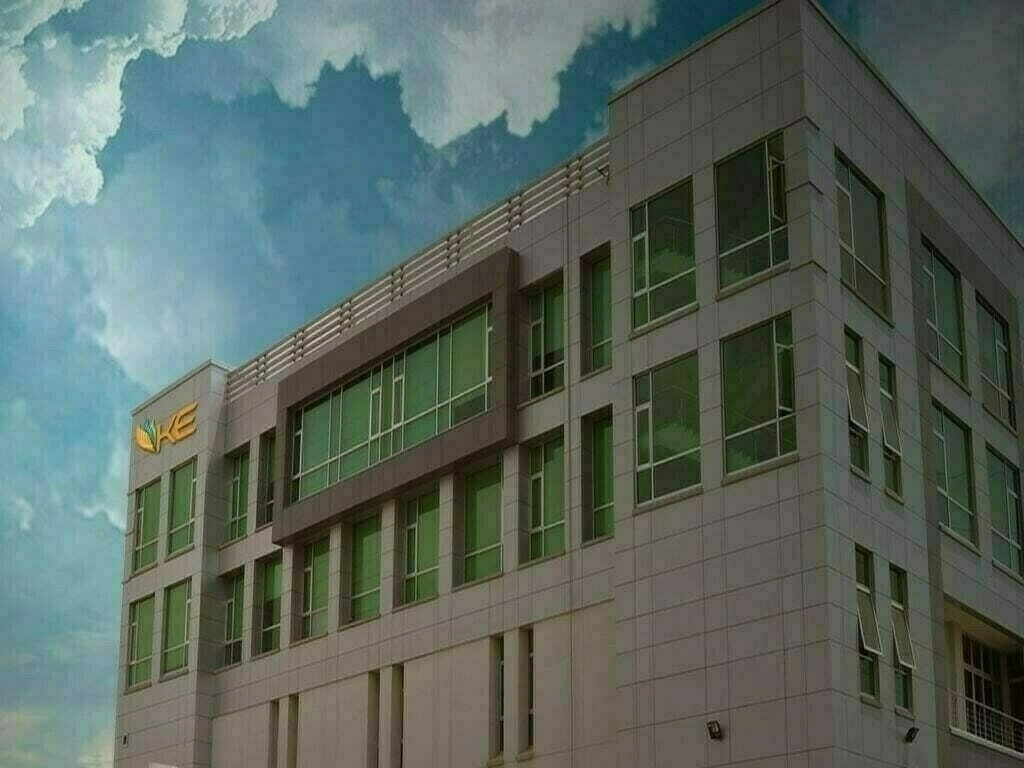
Privatization was supposed to rescue Karachi’s power grid. However, two decades after handing Karachi Electric (KE) to private investors, the city’s homes and businesses continue to suffer from repeat blackouts, erratic billing, stalled investments and even fatalities.

As Islamabad prepares to privatise FESCO, GEPCO, IESCO, and other Discos, the Karachi experience offers important lessons to ensure the rest of Pakistan is not subjected to the horrors that have been inflicted upon 20 million Karachiites for years.

KE’s privatization was pitched as a turning point for the utility, with injection of fresh capital, private expertise and market discipline that would replace the old and inefficient state-run enterprise, and end Karachi’s decades-old legacy of chronic outages.
However, instead of steady power supply and happier consumers, Karachi has come to expect routine load-shedding, unannounced blackouts that stretch entire days, and a utility more focused on protecting profits than ensuring the lights stay on.

Impact on industry and the economy

Karachi is a central pillar of Pakistan’s economy, with its port handling over 60 percent of trade, its factories manufacturing key exports, and its services sector supporting finance, retail and hospitality industries across the country. However, under KE’s erratic supply regime, businesses and industries have to run at partial capacity or resort to expensive captive generation, slashing margins and spooking investors.

Manufacturers of everything from garments to food products wrestle with unannounced blackouts that halt machinery and damage sensitive equipment. A voltage spike during an unscheduled cut can destroy motors, ruin production batches and require costly repairs running into tens of millions of rupees for each incident. Export-oriented factories, bound by tight shipping schedules, miss international delivery windows, damaging reputations and risking contract penalties.

As per a 2024 report before the Sindh Assembly, between 2019 and 2024, at least 81 industrial units—including textile mills, sugar plants and cement factories—had shut down due to KE’s electricity crisis. Each closure translates into hundreds of jobs losses, federal and provincial revenues losses, and a shrinking industrial and export base. Remaining industries often downsize or freeze expansion plans, unwilling to risk fresh investment under an unstable power setup.

To cope, most industrial units have installed diesel generators, gas-fired captive power plants or solar arrays. These stopgap measures are expensive with fuel, maintenance, capital amortization and staff required to run the systems.
Effectively, anyone who wants to manufacture in Pakistan not only has to set up a factory but also multiple power generation systems to hedge against risks from the grid, and hence end up paying twice, once through KE’s tariff and again through backup-power costs. For a garment manufacturer operating on razor-thin margins, a heavy fuel-bill can tip profitability into fateful losses.

Moreover, recent levies on gas and furnace oil for industrial captive power generation are forcing manufacturers onto KE’s grid, where they are furnished with prohibitive connection charges and face lead times of two to three years to get the electricity. We cite the example of a major textile and apparel manufacturer with $400 million in annual exports, employing 35,000 people across different divisions.

The company has one mill under Karachi Electric with a power requirement of 15-20MW. Following the grid transition levy on gas, they shifted to Furnace Oil-fired captive generation that costs around Rs 33/kWh, compared to around Rs. 29-30/kWh on the grid and will shoot to Rs 51/kWh following the levies on FO.

The company would very much prefer to run their operations on the electricity grid under KE, as it is cheaper than FO-fired captive generation even before the levy. However, KE has quoted a cost of PKR 8 billion to provide grid connections to these units, to be paid upfront.

Additionally, they have been told that it would take about 3 years to connect them to the gird, with no guarantee of timely completion or energization. On top of this, the company would be responsible for getting approvals from several government departments (like FWO, railways, local authorities, etc.), which adds further costs and difficulties.

This situation is wholly untenable. The company cannot rely on gas or FO-fired generation for 3 years with punitive levies as it will go out of business. However, paying Rs 8 billion upfront for a grid connection with no guarantee of timely access will push the company towards bankruptcy as well. It is at a dead end, with no viable options.
While this is the story of only one company, and that too one of the largest exporters of Pakistan, the same issues are being faced by export-oriented manufacturers across Karachi. No company can afford to pay billions of rupees for a grid connection, especially without any guarantee of timely completion.

On one hand, the industry is being penalized for using alternate fuels such as gas and FO; on the other hand, it is effectively barred from accessing the grid due to prohibitively high connection charges, excessive lead times, and bureaucratic delays. It is neither reasonable nor practical for the Government to mandate grid transition while distribution companies like KE impose insurmountable barriers to achieving it.

High tariffs, billing controversies and overcharging

Karachi’s power consumers contend with some of the highest electricity rates in the country. Part of this stems from KE’s expensive power generation mix:

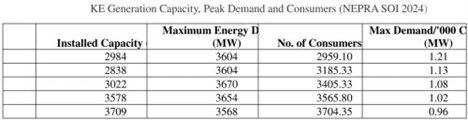
First, despite Karachi’s high peak demand of 3604MW in 2020, KE’s generation capacity stood at 2,984 MW. Between 2020 and 2024, 725 MW (or 25%) of capacity was added against an increase of 745,000 consumers (also 25%). Despite the increase in consumers, peak demand has fallen from 3,604 in 2020 to 3,568 MW in 2024, in line with the rest of the country as the economic crisis, inflation and power tariff hikes have significantly weighed down on consumer demand.


Absent the economic crisis and resulting demand destruction, at the 2020 maximum demand per consumer, KE would have experienced maximum demand of 4,518 MW, resulting in a hypothetical shortfall of 809 MW. As the economy has recovered over the past year and power tariffs have also started going down, demand is expected to recover and the hypothetical shortfall becoming real is not an unlikely scenario.


The expansion of generation capacity has lagged far behind population and industrial growth, and rather than develop new plants, KE leaned on bulk power imports from the national grid—energy whose long-term availability is not guaranteed.


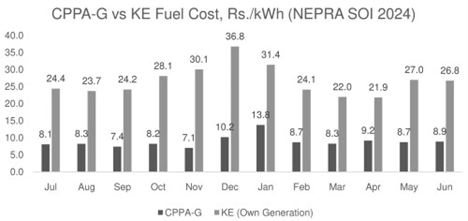
Apart from CPPA-G imports, the utility relies heavily on costly RLNG power plants and continues to run older inefficient units that drive up per-unit costs. This results in KE’s own generation—which comprises a little over half of their mix—fuel costs being two to three times those of CPPA-G during the same months:


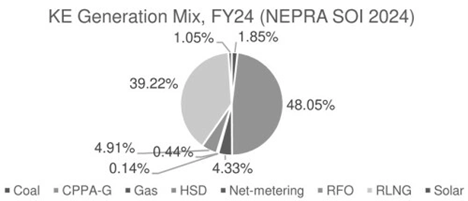
These higher generation costs are passed directly to consumers in the form of fuel cost adjustments and higher base tariffs, burdening Karachiites with inflated bills. Despite a push from the regulator, KE has opted not to diversify their generation mix towards low-cost or renewable sources, with solar (excluding net-metering), for instance, accounting for only 1.05% of the generation mix in 2024.

There have also been instances where KE earned profits above allowable targets but failed to pass on the mandated relief to consumers. It has repeatedly used legal loopholes and regulatory inertia to avoid returning excess profits to its consumers, despite clear mandates under its Multi-Year Tariff (MYT) framework. According to NEPRA rules, when KE earns profits above its allowable return—set at 12% on its regulated asset base—it is obligated to share that windfall with consumers through reduced tariffs under a “claw-back” mechanism.

However, KE has consistently delayed these payments by either failing to file the required adjustments or taking the matter to court to stall enforcement. In 2021, for example, NEPRA calculated that KE owed consumers roughly Rs 43.6 billion, but KE challenged the order and secured a stay through court. As a result, billions of rupees in relief—some of it approved by NEPRA as far back as 2018—remain unreimbursed, even as consumers face a cost-of-living crisis.

At the same time, KE has sought massive write-offs for unrecovered consumer dues—amounting to over Rs. 76 billion during the 2017–2023 tariff period—without establishing effective recovery mechanisms or transparency. While NEPRA approved Rs. 50 billion of this amount with the condition that any future collections must be passed back to consumers, given KE’s track-record, it is highly unlikely it will honour this requirement.

Thus, the company benefits twice: once by claiming write-offs and again by retaining any future recoveries. These tactics reveal a broader pattern where KE actively exploits the system to shift financial risk onto the public while shielding its own bottom line.

These episodes underscore a trust deficit where consumers see a company quick to charge more, but very slow and litigious when it comes to giving money back. In fact, KE was also involved in the infamous over-billing scandal of July-August 2023, where NEPRA exposed billing fraud across multiple DISCOs.

Meter readings were manipulated to extend billing cycles beyond 30 days and push customers into higher tariff slabs, and phantom “detection charges” for alleged theft or meter tampering appeared without supporting meter-snapshot evidence, suggesting wilful malpractice.

KE’s own numbers tell the story: during July through December 2024, for example, it received 855,843 consumer complaints, by far the highest across all DISCOs despite serving a much smaller consumer base.

Normalising by number of consumers, KE received twice as many complaints per consumer compared to the next highest LESCO. The pattern is also apparent over time as, in FY2021-22 for instance, KE received 1,543,091 complaints, over twice the second highest of LESCO, with 768,076 complaints.

The high complaint rate highlights the prevalence of service problems under KE, with common complaints including incorrect meter readings, billing errors, delayed adjustments, and poor responsiveness in resolving issues. While it is possible that KE’s customer service infrastructure is more accessible than other Discos, the persistent complaints also point towards underlying issues remaining inadequately addressed.

Safety lapses and infrastructure failures


Beyond reliability and billing, serious safety and infrastructure issues have plagued KE’s performance, often with deadly consequences. Aging, under-maintained equipment and poor safety oversight have endangered lives and highlight the utility’s negligence in upgrading its network.

Numerous electrocutions have occurred in recent years, especially during monsoon season when stray wires and faulty equipment turn lethal. In FY23, for example, 33 people died due to electrocution in KE service areas. Following an investigation of these incidents, Nepra attributed one fatality (a lineman’s death) to direct negligence on KE’s part, having failed basic safety protocols like not properly isolating high-voltage lines while work was being done, inadequate site supervision, and conducting work in an unplanned and haphazard manner. It imposed a fine of Rs 10 million on KE as a result and ordered compensation of Rs 3.5 million to the family of the victim.

“Privatisation should have financed grid modernization with upgraded transformers, insulated cables, remote monitoring and rapid-response crews. Instead, KE’s network shows signs of chronic underinvestment as overloaded feeders trip frequently, and announcements of high-voltage line upgrades or smart grid projects often stall after initial fanfare.”

Lack of adequate transmission capacity is in fact one of the reasons KE has to rely on costly RLNG-based generation while cheaper generation capacity under CPPA-G goes unutilized, causing Karachi’s power consumers to face much higher costs than the rest of the country.


LOCATIONS

Where We Are


GET IN TOUCH

Follow Our Activity


IslamabadKarachiLahore